
Want to Start a Laundromat? Here’s What You Need Before Investing
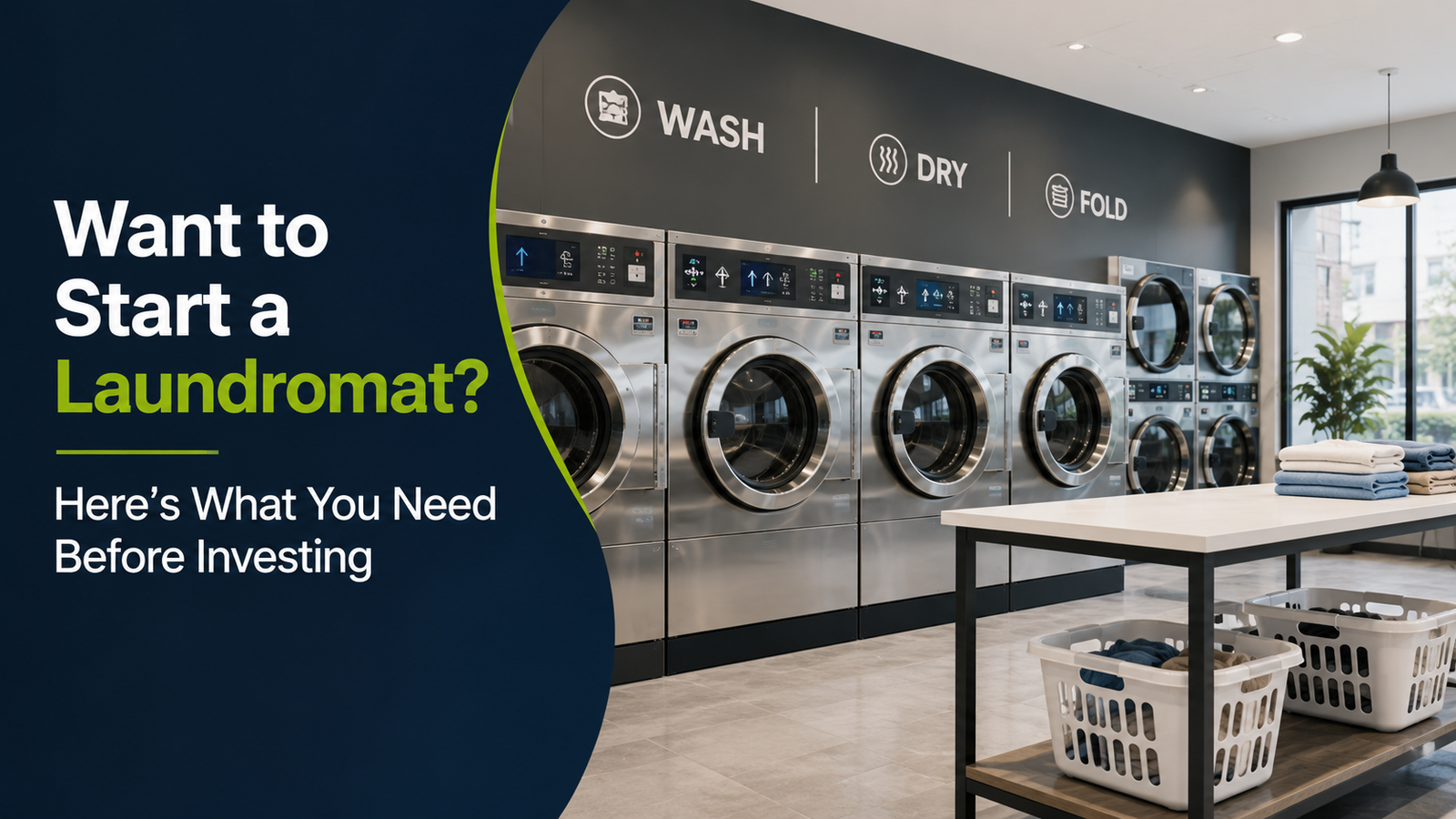
The laundromat model can be attractive to entrepreneurs looking for a service business built around recurring demand, standardized operations, and scalable equipment. But buying a few washing machines and opening a shop does not automatically create a profitable laundromat business.
Location, customer demand, machine capacity, utilities, pricing, operating costs, and equipment utilization all influence whether the investment works commercially.
Before choosing laundromat solutions, you need to understand how the business will operate, who will use it, how much laundry you expect to process, and what equipment can support that demand. Planning these factors before investing can prevent expensive changes later.
Is a Laundromat a Good Business to Start?
A laundromat can be a practical business model in areas where customers need convenient access to reliable washing and drying facilities. Potential markets include students, working professionals, tenants, hostels, paying-guest accommodations, apartment communities, and customers who lack suitable laundry facilities at home.
The attraction is that washing and drying are recurring requirements. Once the right location and operating model are established, customers may return regularly.
However, laundromat business profit depends heavily on machine utilization. Expensive equipment sitting unused for most of the day will make recovering the initial investment more difficult.
How Does a Self-Service Laundromat Business Work?
In a self-service laundromat, customers bring their laundry, select an available machine, choose the required program, make payment, and operate the equipment themselves.
Depending on the business model, payment may be handled through coins, cards, tokens, digital systems, or other supported payment methods.
Some businesses remain completely self-service, while others combine self-service with assisted washing, wash-and-fold, ironing, pickup and delivery, or premium garment-care services.
This hybrid approach can allow the same location to serve different customer segments and create additional revenue streams.
Is a Laundromat Business Profitable in India?
A laundromat business in India can be profitable when the location, pricing, equipment, and operating model are aligned with actual customer demand.
Profitability depends on factors such as the following:
-
Number of paying loads per day
-
Average revenue per customer
-
Washer and dryer utilization
-
Rent
-
Water and energy costs
-
Labour requirements
-
Maintenance expenses
-
Additional services offered
Instead of asking only whether laundromats are profitable, investors should calculate how many paid cycles their specific location needs each day to cover fixed and variable costs.
What Should You Research Before Investing in a Laundromat?
Start with the customer, not the machines.
Research who lives or works around the proposed location and how they currently manage their laundry. Study nearby hostels, apartments, universities, offices, rental accommodation, and competing laundry services.
Also investigate local pricing and customer expectations.
Before committing to a laundromat investment, estimate expected daily transactions under conservative, realistic, and high-demand scenarios. This provides a much better foundation for equipment and financial planning.
How Much Investment Is Required to Start a Laundromat?
There is no universal laundromat startup cost because every project is different.
Investment may include:
Commercial laundry equipment + interiors + electrical work + plumbing + drainage + water storage/treatment where required + ventilation + payment systems + furniture + signage + deposits + working capital.
Property cost can significantly affect the total investment, particularly in high-rent locations.
Rather than calculating only machine prices, prepare a complete project budget. Keep additional capital available for operating expenses during the initial customer-acquisition period.
What Equipment Do You Need to Start a Laundromat?
The core laundromat equipment generally consists of commercial washing and drying machines.
Depending on the business model, supporting equipment may include payment systems, water treatment, laundry carts, folding tables, seating, storage, and other operational infrastructure.
The important distinction is commercial equipment versus domestic appliances.
Machines in a laundromat may operate repeatedly throughout the day. Equipment should therefore be selected according to expected commercial usage, cycle requirements, serviceability, and long-term operating conditions.
How Many Washers and Dryers Should a New Laundromat Have?
The correct number of laundromat machines depends on expected demand rather than a fixed formula.
A small startup may begin with fewer machines and expand as utilization grows. A high-traffic location may require several machines from the beginning to prevent customers from waiting.
Calculate:
Expected customers per day × average loads per customer × peak-hour concentration
Then compare that requirement with practical machine cycles per hour.
Also consider redundancy. If a laundromat depends on a single washer or dryer, maintenance can significantly affect available capacity.
What Washer and Dryer Capacity Should You Choose?
Not every customer arrives with the same amount of laundry.
Providing different machine capacities can allow customers to select equipment according to their load size. Larger machines can also serve customers washing bulky items where appropriate.
Your commercial washer and dryer configuration should reflect typical customer loads and expected peak demand.
Drying capacity deserves equal attention. Installing substantial washing capacity without sufficient drying capacity can create queues at the second half of the process.
The objective should be balanced throughput across the complete customer journey.
How Important Is Location for a Laundromat Business?
Location can be one of the biggest factors influencing laundromat performance.
A strong site combines customer demand with convenience and visibility.
Look for proximity to target customers, accessible ground-floor locations where possible, parking or easy pedestrian access, suitable operating hours, and sufficient utility infrastructure.
A cheaper property with weak customer demand may ultimately cost more than a better-positioned site with higher rent.
For a self-service laundry business, convenience is part of the product.
How Much Space Do You Need for a Self-Service Laundry?
Space requirements depend on machine quantity, equipment dimensions, customer movement, folding areas, seating, service areas, and utility infrastructure.
Do not calculate space by simply adding machine footprints.
Allow room for door opening, equipment servicing, ventilation, customer movement, laundry carts, utility connections, and future expansion.
Before finalizing a property, develop the laundromat setup layout around the actual equipment specifications.
This prevents discovering after signing a lease that the space cannot support the planned machines or utilities.
What Are the Monthly Operating Costs of a Laundromat?
Typical operating expenses can include:
-
Rent
-
Electricity or other energy
-
Water
-
Detergents and consumables
-
Labour
-
Equipment maintenance
-
Payment-system costs
-
Internet/software where applicable
-
Cleaning and housekeeping
-
Marketing
-
Repairs and replacements
These costs should be converted into an estimated cost per paid cycle.
That makes it easier to determine whether your proposed pricing leaves enough contribution to cover fixed expenses and generate profit.
How Much Can a Laundromat Earn?
Revenue depends largely on machine utilization.
A simple starting calculation is:
Paid cycles per day × average revenue per cycle × operating days = estimated monthly machine revenue
Then add revenue from additional services such as drying, wash-and-fold, ironing, pickup and delivery, or other services offered by the business.
Do not confuse revenue with laundromat business profit. Rent, utilities, maintenance, labour, consumables, taxes, and other operating expenses still need to be deducted.
How Long Can It Take to Recover Your Laundromat Investment?
The laundromat ROI depends on total investment and actual operating profit.
A simplified payback calculation is:
Total initial investment ÷ annual operating profit = estimated payback period
For example, two laundromats with identical equipment costs can produce very different returns if one completes significantly more paid cycles per machine.
That is why utilization should be central to your financial model.
Use conservative assumptions when preparing projections rather than calculating returns from maximum theoretical machine capacity.
Common Mistakes to Avoid Before Opening a Laundromat
One of the biggest mistakes is purchasing equipment before validating demand.
Other common problems include choosing a low-visibility location solely because rent is cheaper, underestimating utility requirements, installing mismatched washer and dryer capacity, ignoring maintenance access, and spending the entire budget on equipment without retaining working capital.
Another mistake is overbuilding from day one.
A carefully planned commercial laundry setup that can expand may be financially safer than installing excessive capacity before customer demand exists.
What Should You Look for in a Laundromat Solutions Provider?
Your supplier should do more than quote machine prices.
Look for a provider capable of helping evaluate equipment capacity, machine configuration, layout, utilities, installation requirements, operating workflow, and future expansion.
After-sales support also matters because equipment downtime directly affects revenue in a self-service operation.
When comparing laundromat solutions, consider the complete lifecycle of the equipment—not only the initial purchase price.
How Orgaearth Can Help
Orgaearth provides commercial laundry equipment and laundromat solutions for entrepreneurs planning new self-service and professional laundry businesses.
The process can begin with understanding expected customer volume, available space, utilities, business model, and investment requirements. Based on these factors, an appropriate combination of commercial washing machines and dryers can be planned.
Orgaearth can also support laundromat projects with equipment selection, layout and capacity planning, installation and commissioning, operator guidance, maintenance requirements, and supporting laundry solutions.
For entrepreneurs entering the laundry business in India, this approach helps ensure the equipment investment is based on practical business requirements rather than machine specifications alone.
Conclusion
Orgaearth Laundry Solutions
Plot no. 714, Udyog Vihar, Phase 5, Gurugram, Haryana, India 122016
Email: marketing@orgaearth.com
Contact No.: +91 7042912777
FAQs
What equipment is required to start a laundromat?
A laundromat primarily requires commercial washing machines and dryers. Depending on the operating model, additional requirements may include payment systems, folding tables, laundry carts, seating, water treatment, storage, and supporting utility infrastructure.
How much does it cost to start a laundromat in India?
The cost varies according to machine quantity and capacity, location, property expenses, interiors, plumbing, electrical infrastructure, payment technology, and working capital. A complete project budget should therefore be prepared rather than estimating the investment from equipment prices alone.
Is a laundromat business profitable?
A laundromat can be profitable when there is sufficient customer demand and machine utilization to cover rent, utilities, maintenance, labour, and other operating expenses. Location, pricing, equipment efficiency, and additional services strongly influence profitability.
How many washing machines do I need for a laundromat?
There is no fixed number. Estimate expected daily customers, loads per customer, peak-hour demand, machine cycle time, and desired redundancy. New businesses can sometimes start with a smaller configuration that allows additional machines to be installed as demand grows.
What is the ROI of a laundromat business?
Laundromat ROI depends on the initial investment and the operating profit generated by the business. Machine utilization is particularly important because higher numbers of paid cycles allow the same equipment investment to generate more revenue.
How much space is required for a self-service laundromat?
Required space depends on machine quantity, equipment dimensions, customer areas, folding space, utility infrastructure, service clearances, and future expansion plans. The layout should be developed around the actual equipment before committing to a property.
Can I start a laundromat with a small investment?
A smaller laundromat can be possible when equipment quantity, location, services, and infrastructure are carefully planned. Instead of minimizing investment at all costs, focus on creating a viable initial setup that can expand when customer demand justifies additional capacity.
- Business
- Technology
- Finance
- Health
- Fashion
- Lifestyle
- Travel
- Food
- Education
- Real Estate
- Automobile
- Entertainment
- Sports
- Pets
- Home Decor
- Gardening
- Parenting
- Wedding
- Beauty
- Gaming
- Photography
- Music
- Movies
- News
- Politics
- Religion
- Astrology
- Law
- Insurance
- Jobs
- Freelancing
- Remote Work
- Blogging
- E-commerce
- WordPress
- OpenCart
- Social Media
- Graphic Design
- Web Design
- Programming
- Mobile Apps
- Artificial Intelligence
- SaaS
- Cyber Security
- Cloud Computing
- Hosting
- SEO
- Content Writing
- Email Marketing
- Affiliate Marketing
- YouTube
- Podcasting
- Interior Design
- DIY
- Crafts
- Art
- Architecture
- Environment
- Agriculture
- Animals
- Fishing
- Hunting
- Survival
- Outdoor
- Fitness
- Yoga
- Meditation
- Mental Health
- Skin Care
- Hair Care
- Makeup
- Jewelry
- Sarees
- Salwar Kameez
- Lehenga Choli
- Kurtis
- Men Fashion
- Women Fashion
- Kids Fashion
- Footwear
- Bags
- Watches
- Luxury
- Shopping
- Coupons
- Electronics
- Smartphones
- Laptops
- Tablets
- Cameras
- Home Appliances
- Kitchen
- Furniture
- Cleaning
- Baby Care
- Senior Care
- Relationships
- Self Improvement
- Motivation
- Quotes
- Festivals
- Events
- Careers
- Remote Work
- Productivity
- Wholesale
- Manufacturing
- Import Export
- Logistics
- Supply Chain
- Human Resources
- Customer Service
