
The Site Prep Costs That Blow Up Budgets Before Construction Even Begins
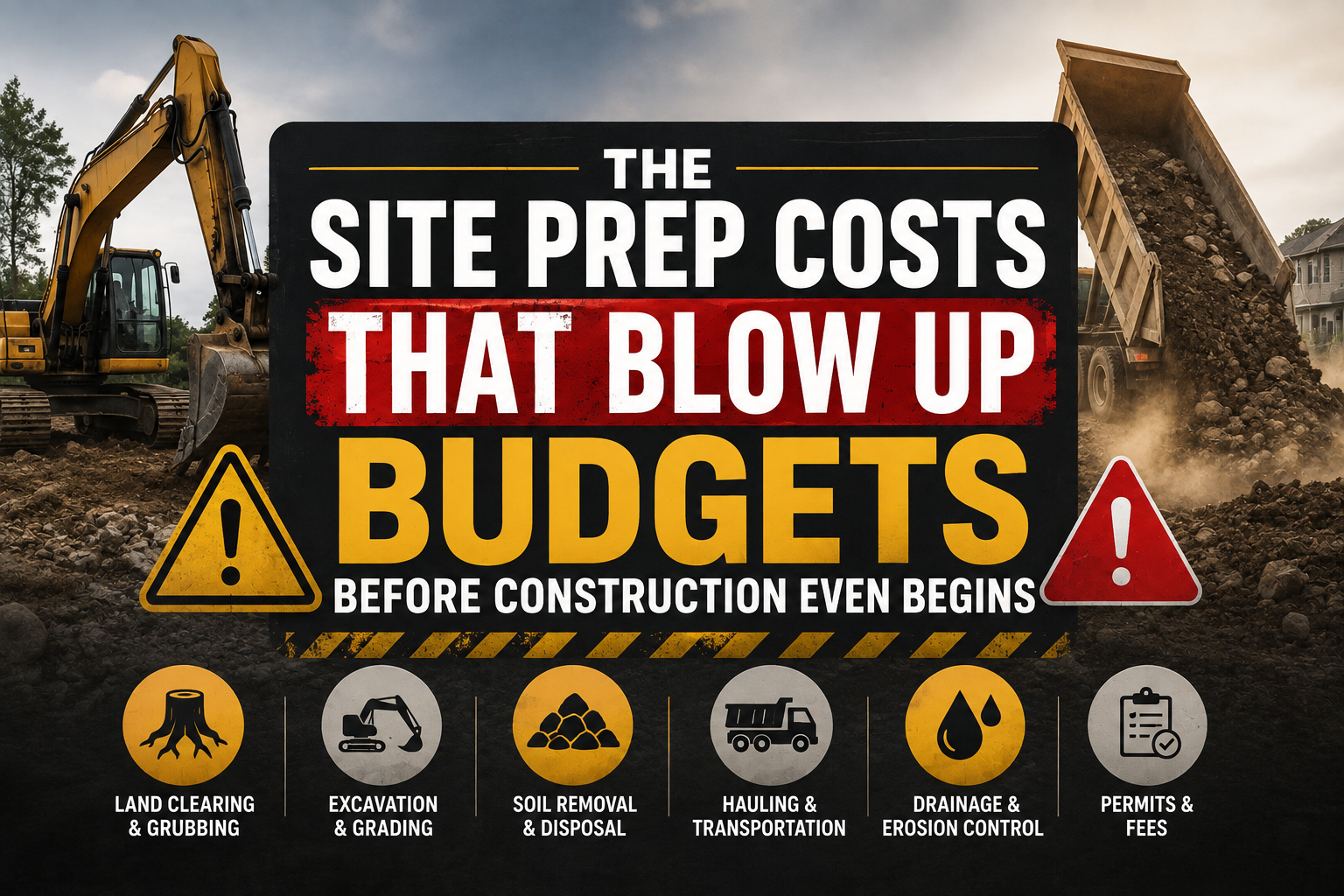
Ask a project manager which phase of a build tends to go over budget most often, and a surprising number will point to something that happens before the building itself is even framed: the sitework. Grading, excavation, drainage, utility trenching the unglamorous groundwork that has to be right before anything else can go up. It rarely makes it into a project's marketing renderings, but it's often where the real financial risk lives.
Why Sitework Estimates Go Wrong More Than Other Trades
Most construction trades deal with fairly predictable variables. A framer knows roughly how much lumber a house needs once the square footage and design are set. Sitework doesn't have that luxury it's dealing with something no one fully controls: the ground itself.
Soil composition changes across a single lot, sometimes across a single foundation footprint. Rock that wasn't flagged in a geotechnical report can turn a straightforward excavation into a blasting job. Water tables shift with the season. None of these show up clearly on a blueprint, which is exactly why sitework estimating requires more than measuring lines on a drawing; it requires understanding what's actually underneath them.
Cut and Fill: The Calculation Most People Underestimate
If there's one concept that separates a rough sitework guess from a defensible number, it's cut-and-fill analysis figuring out how much soil needs to be removed versus how much needs to be brought in to bring a site to grade. Get this wrong in either direction and the consequences compound quickly:
-
Under-calculate cut, and you're paying for unplanned hauling and disposal mid-project
-
Under-calculate fill, and you're sourcing and trucking in material you didn't budget for
-
Miss the soil's shrinkage or swell factor, and both of the above happen even when your initial numbers looked right on paper
Balanced earthwork minimizing how much material has to travel on or off site is one of the more overlooked ways sitework costs can be controlled, but it only works if the initial volume calculations were accurate to begin with.
The Utility Layer Nobody Sees Until It's a Problem
Underground utilities are another place where sitework budgets quietly unravel. Sewer lines, storm drainage, water distribution all of it has to be estimated based on plans that don't always reflect what's actually below grade, especially on sites with existing infrastructure or unclear as-built records.
A thorough sitework estimate accounts for pipe sizing, trench depth, bedding material, and connection points in detail, rather than applying a rough per-linear-foot number across the board. The projects that run into utility-related change orders are almost always the ones where this step got compressed to save time during bidding.
Soil Isn't Optional Homework It's the Foundation of the Number
Every sitework estimate depends on a handful of soil-specific factors that are easy to skip when time is tight: shrinkage factor, swell factor, load factor, and soil classification. These aren't academic details; they directly determine how much material actually needs to move, and moving material is where sitework costs concentrate. A cut-and-fill volume that ignores swell factor, for example, can understate hauling costs by a meaningful margin without anyone noticing until the trucks are already on site.
Why More Contractors Are Outsourcing This Specific Piece
Given how many variables sitework estimating has to account for soil behavior, utility routing, grading methods, equipment costs that shift by region it's become one of the more common estimating tasks contractors choose to hand off rather than absorb in-house, particularly on projects with tight bid timelines. This overview of sitework estimating services walks through what a dedicated sitework estimate typically covers, from initial document review through cut-and-fill methodology and final cost breakdowns by CSI division.
The Takeaway
Sitework doesn't get the attention that a striking facade or a complex structural system gets, but it's often the phase that determines whether a project's early budget holds up. Getting it right requires treating the ground itself as seriously as everything that eventually sits on top of it because from a budgeting standpoint, that's exactly what it is.
- Business
- Technology
- Finance
- Health
- Fashion
- Lifestyle
- Travel
- Food
- Education
- Real Estate
- Automobile
- Entertainment
- Sports
- Pets
- Home Decor
- Gardening
- Parenting
- Wedding
- Beauty
- Gaming
- Photography
- Music
- Movies
- News
- Politics
- Religion
- Astrology
- Law
- Insurance
- Jobs
- Freelancing
- Remote Work
- Blogging
- E-commerce
- WordPress
- OpenCart
- Social Media
- Graphic Design
- Web Design
- Programming
- Mobile Apps
- Artificial Intelligence
- SaaS
- Cyber Security
- Cloud Computing
- Hosting
- SEO
- Content Writing
- Email Marketing
- Affiliate Marketing
- YouTube
- Podcasting
- Interior Design
- DIY
- Crafts
- Art
- Architecture
- Environment
- Agriculture
- Animals
- Fishing
- Hunting
- Survival
- Outdoor
- Fitness
- Yoga
- Meditation
- Mental Health
- Skin Care
- Hair Care
- Makeup
- Jewelry
- Sarees
- Salwar Kameez
- Lehenga Choli
- Kurtis
- Men Fashion
- Women Fashion
- Kids Fashion
- Footwear
- Bags
- Watches
- Luxury
- Shopping
- Coupons
- Electronics
- Smartphones
- Laptops
- Tablets
- Cameras
- Home Appliances
- Kitchen
- Furniture
- Cleaning
- Baby Care
- Senior Care
- Relationships
- Self Improvement
- Motivation
- Quotes
- Festivals
- Events
- Careers
- Remote Work
- Productivity
- Wholesale
- Manufacturing
- Import Export
- Logistics
- Supply Chain
- Human Resources
- Customer Service
