
Aircraft Seals Market Share Landscape to Expand Toward USD 2.5 Billion by 2034
Market Overview and Growth Outlook
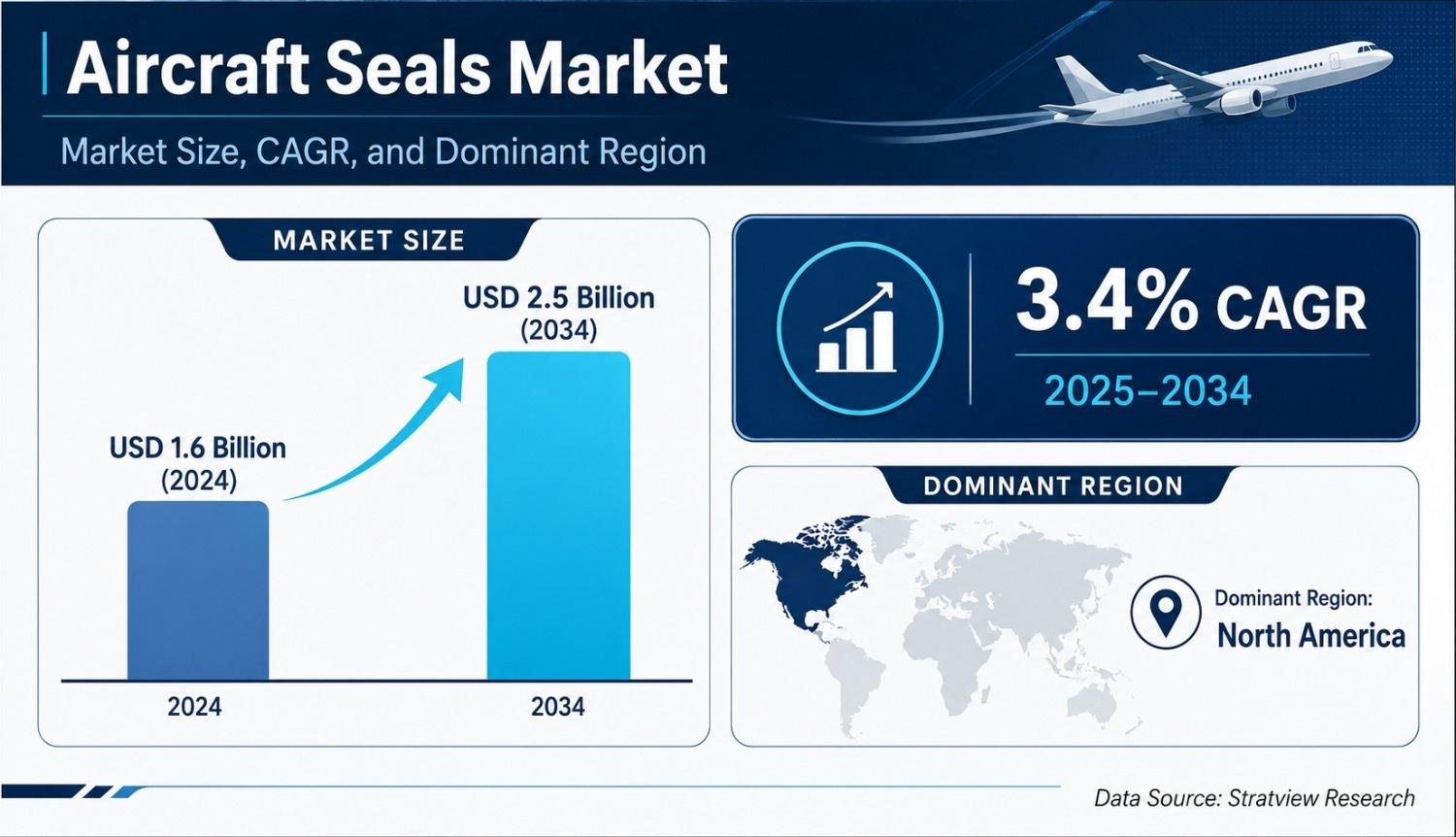
The Aircraft Seals Market reached USD 1.6 billion in 2024 after recording 6.6% year-over-year growth. Annual demand is expected to increase to USD 1.8 billion in 2025 and USD 2.5 billion by 2034, supported by aircraft production, fleet modernization, and continuing maintenance requirements.
The Aircraft Seals Market is expected to grow at a CAGR of 3.4% during 2025–2034. Cumulative sales opportunities are forecast at USD 22.6 billion, while the top ten companies accounted for an estimated 50%–70% of the market in 2024.
The competitive landscape reflects demanding product requirements. Aircraft seals must perform under extreme temperature changes, high pressure, vibration, and chemical exposure. Certification and qualification standards require extensive testing for safety, durability, and compliance, creating long development cycles and meaningful barriers to entry.
Analysis of Aircraft Seals Market share therefore requires attention to engineering performance, product qualification, material expertise, application coverage, and regional capabilities. Suppliers serving both OE and Aftermarket demand are positioned across production installations and recurring replacement cycles.
Request a free sample report:
https://www.stratviewresearch.com/Request-Sample/aircraft-seals-market#form
Market Segmentation Analysis
By Aircraft Type, the market includes Commercial Aircraft, Regional Aircraft, Helicopter, Military Aircraft, and General Aviation. Commercial Aircraft are likely to be the biggest demand generator during the forecast period because of aircraft production, fleet activity, and extensive component requirements.
By Application Type, the categories are Airframe, Nacelles & Engines, Aircraft Interiors, Landing Gears wheels & brakes, Flight Control Actuation & Hydraulics, and Other Applications. Airframe is expected to dominate because seals are essential across wings, fuselages, doors, and access panels.
By Function Type, the categories are Aerodynamic Surface Sealing, Air & Fluid Management Seals, Fire Seals, Conductive & Insulative Seals, and Other Functions. Aerodynamic Surface Sealing is forecast to remain dominant, while Fire Seals are expected to grow fastest.
By Material Type, the market comprises Elastomeric Seals, Thermoplastic Seals, and Metallic Seals. Elastomeric Seals are anticipated to remain dominant and fastest-growing, supported by flexibility, durability, and resistance to harsh operating environments.
By Motion Type, the categories are Static Seals, Linear Seals, and Rotary Seals, with Rotary Seals expected to record the fastest growth. By End-User Type, the market includes OE and Aftermarket. OE is projected to remain the key demand generator.
Regional Market Insights
North America is expected to remain the dominant regional market. Its aerospace manufacturing presence, commercial and military aircraft fleets, defense activity, maintenance network, regulatory requirements, and continuous aircraft servicing create sustained demand for sealing products.
Asia-Pacific is expected to register the fastest growth. Expanding aviation activity and increasing aircraft requirements are strengthening demand for seals across production, maintenance, structural, engine, hydraulic, and flight-control applications.
Emerging Trends Shaping the Aircraft Seals Market
Competitive positioning is increasingly linked to advanced materials. PTFE, FFKM, PEEK, fire-resistant elastomers, and low-permeability elastomers address demanding thermal, chemical, fluid-management, and fire-protection requirements.
Fire Seals are expected to grow faster than other function types as regulatory standards and aircraft designs increase the importance of heat containment and flame-propagation prevention in engines and nacelles.
Engine MRO is another strategic area. More sophisticated maintenance cycles are supporting demand for seals that improve reliability, thermal resistance, leakage control, and service intervals.
Key Growth Drivers of the Market
- Aircraft manufacturing: Production growth raises OE demand across every major aircraft system and increases the addressable market for qualified suppliers.
- Recurring replacement: Seal exposure to heat, pressure, vibration, fuels, and hydraulic fluids creates repeat demand throughout aircraft operating lives.
- Fleet modernization: Modern aircraft require efficient, lightweight, and reliable sealing solutions that support safety, pressurization, and system performance.
- Certification requirements: Strict standards favor manufacturers with proven testing, material engineering, durability, and compliance capabilities.
- Advanced aviation systems: New propulsion concepts and sustainable fuels increase demand for materials with stronger thermal and chemical compatibility.
Competitive Landscape
Top Companies in the Market
Hutchinson SA
Trelleborg AB
Parker Hannifin Corporation
Freudenberg Group
SKF Group
Green Tweed & Co.
EnPro Industries
Saint-Gobain S.A.
Conclusion and Strategic Outlook
The Aircraft Seals Market is forecast to grow from USD 1.6 billion in 2024 to USD 2.5 billion in 2034, at a CAGR of 3.4% during 2025–2034. The market’s trajectory rests on production volumes, operating-fleet growth, modernization, maintenance demand, safety regulations, and advanced materials.
The competitive environment will continue to reflect stringent qualification demands and complex operating conditions. Companies with broad application capabilities, high-performance materials, precise engineering, and established aerospace relationships will remain important contributors to the evolving market structure.
FAQs – Aircraft Seals Market
1. What is the revenue forecast for the Aircraft Seals Market?
The Aircraft Seals Market is projected to reach USD 2.5 billion by 2034. Its value was USD 1.6 billion in 2024, with USD 1.8 billion expected in 2025.
2. What CAGR is expected during the forecast period?
The Aircraft Seals Market is expected to expand at a CAGR of 3.4% during 2025–2034. Cumulative sales opportunities are projected to reach USD 22.6 billion during the same period.
3. What is driving competitive demand?
Aircraft production, fleet modernization, MRO activity, strict safety requirements, and advanced-material adoption drive demand. These factors increase requirements for both factory-installed and replacement sealing systems.
4. Which region holds the leading market position?
North America is expected to remain the dominant region in the Aircraft Seals Market. Asia-Pacific is forecast to be the fastest-growing region through 2034.
5. What risks should potential investors consider?
Qualification barriers, development costs, extended certification cycles, and harsh operating conditions are major considerations. Suppliers also require continued research to control material degradation and maintain sealing reliability.
- Business
- Technology
- Finance
- Health
- Fashion
- Lifestyle
- Travel
- Food
- Education
- Real Estate
- Automobile
- Entertainment
- Sports
- Pets
- Home Decor
- Gardening
- Parenting
- Wedding
- Beauty
- Gaming
- Photography
- Music
- Movies
- News
- Politics
- Religion
- Astrology
- Law
- Insurance
- Jobs
- Freelancing
- Remote Work
- Blogging
- E-commerce
- WordPress
- OpenCart
- Social Media
- Graphic Design
- Web Design
- Programming
- Mobile Apps
- Artificial Intelligence
- SaaS
- Cyber Security
- Cloud Computing
- Hosting
- SEO
- Content Writing
- Email Marketing
- Affiliate Marketing
- YouTube
- Podcasting
- Interior Design
- DIY
- Crafts
- Art
- Architecture
- Environment
- Agriculture
- Animals
- Fishing
- Hunting
- Survival
- Outdoor
- Fitness
- Yoga
- Meditation
- Mental Health
- Skin Care
- Hair Care
- Makeup
- Jewelry
- Sarees
- Salwar Kameez
- Lehenga Choli
- Kurtis
- Men Fashion
- Women Fashion
- Kids Fashion
- Footwear
- Bags
- Watches
- Luxury
- Shopping
- Coupons
- Electronics
- Smartphones
- Laptops
- Tablets
- Cameras
- Home Appliances
- Kitchen
- Furniture
- Cleaning
- Baby Care
- Senior Care
- Relationships
- Self Improvement
- Motivation
- Quotes
- Festivals
- Events
- Careers
- Remote Work
- Productivity
- Wholesale
- Manufacturing
- Import Export
- Logistics
- Supply Chain
- Human Resources
- Customer Service
