
Aircraft Pumps Market to Reach USD 8.0 Billion by 2034 as Aviation Demand Expands
Market Overview and Growth Outlook
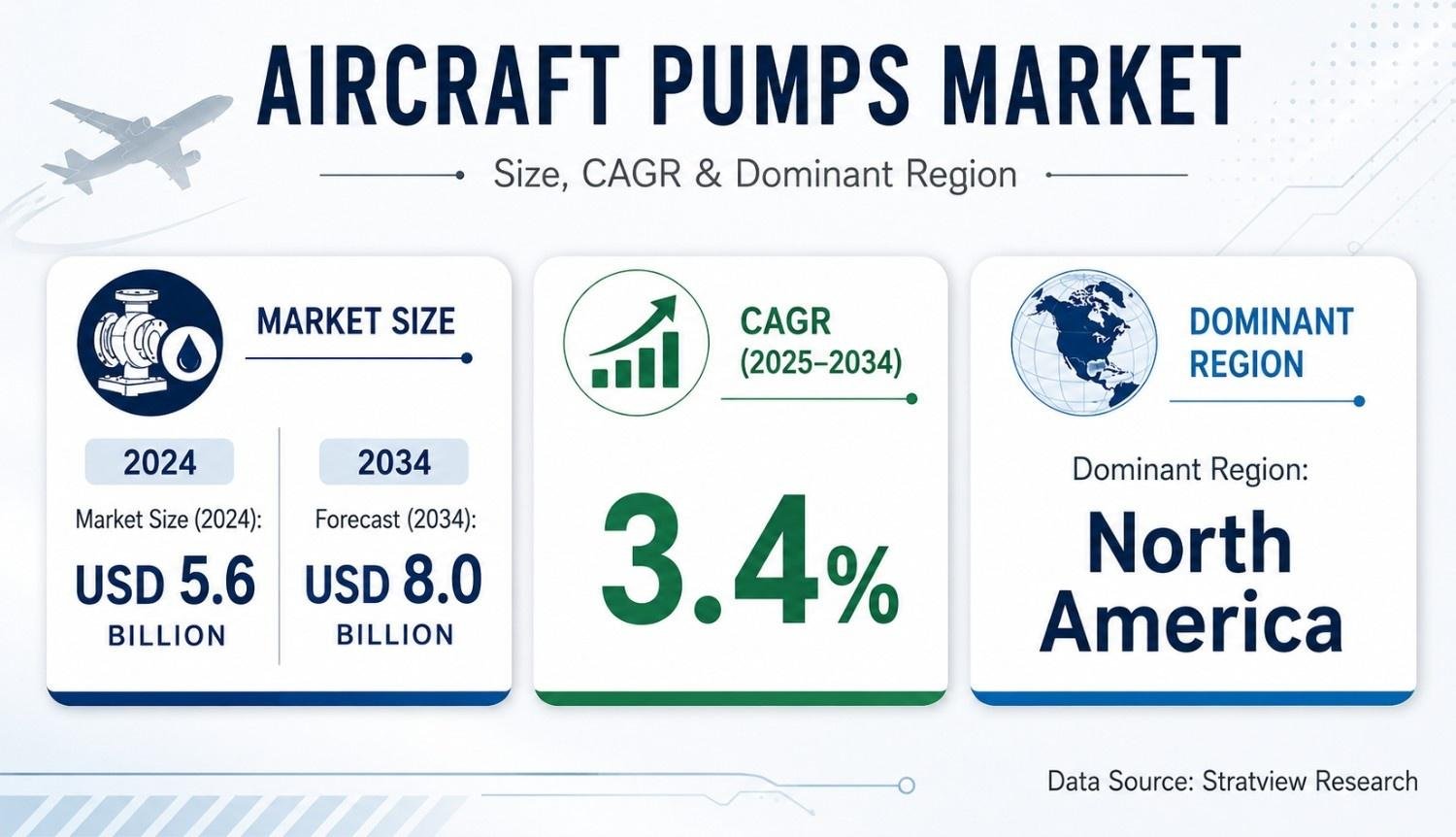
The Aircraft Pumps Market was valued at USD 5.6 billion in 2024, following USD 5.0 billion in 2023 and year-on-year growth of 10.9%. The market is projected to reach USD 5.9 billion in 2025 and USD 8.0 billion by 2034. The forecast reflects sustained requirements across aircraft production, fleet modernization, military aviation, and maintenance activities.
“The Aircraft Pumps Market is expected to grow at a CAGR of 3.4% during 2025–2034.” The industry is also projected to generate cumulative sales opportunities of USD 71.9 billion during this period. Increasing global air travel, expanding commercial airline fleets, defense modernization, rising aircraft production, and demand for fuel-efficient systems are supporting the long-term growth trajectory.
Aircraft pumps supply fuel, hydraulic power, lubrication, and coolant fluids to flight controls, landing gear, engines, and environmental control units. Their role in operational safety and system reliability creates demand across new aircraft and in-service fleets. These fundamentals provide important context for assessing Aircraft Pumps Market trends across technology, application, aircraft, and end-user categories.
Request a free sample report:
https://www.stratviewresearch.com/Request-Sample/aircraft-pumps-market#form
Market Segmentation Analysis
Aircraft-Type Analysis includes Commercial Aircraft, Military Aircraft, Regional Aircraft, Business Jet, and Helicopter. Commercial Aircraft are expected to remain the dominant and fastest-growing aircraft type. Large-scale operations, high production rates, fleet expansion, maintenance requirements, and continuing upgrades generate demand for pumps used in fuel delivery, hydraulic control, lubrication, and cooling.
Pump-Type Analysis includes Fuel Pumps, Hydraulic Pumps, Lube & Scaenge Pumps, Water & Wastewater Pumps, and Air Conditioning & Cooling Pumps. Hydraulic Pumps are expected to contribute the largest share and are identified as the fastest-growing pump type. Their high power density supports landing gear, flight controls, brakes, thrust reversers, and other high-load functions.
Application-Type Analysis includes Hydraulic System, Engine, Auxiliary & Emergency Applications, Gearbox, Onboard Lavatory System, and ECS. Hydraulic System is expected to remain dominant because pumps generate the pressure required for critical control and actuation functions. Gearbox is the fastest-growing application, supported by lubrication, cooling, and pressure-regulation needs in advanced engines and propulsion systems.
Technology-Type Analysis includes Engine-Driven Pumps, Electric Motor-Driven Pumps, and Others. Engine-Driven Pumps are expected to hold the major share because of their reliability, strong power output, continuous operation, and established integration with conventional engines. Electric Motor-Driven Pumps are expected to grow fastest as More Electric Aircraft architectures increase demand for flexible, on-demand operation.
Category-Type Analysis includes Positive Displacement Pumps and Nonpositive Displacement Pumps. Positive Displacement Pumps are projected to maintain their lead throughout the study period. The category includes Fixed Displacement Pumps and Variable Displacement Pumps, while Nonpositive Displacement Pumps include Centrifugal Pump and Others. These classifications reflect different fluid-transfer and aircraft-system requirements.
End-User-Type Analysis includes OE and Aftermarket. OE is expected to remain dominant and faster-growing as increasing aircraft production, fleet modernization, and the introduction of fuel-efficient aircraft raise demand for pump installations. The aftermarket remains supported by maintenance, replacement, repair, and upgrade requirements across long-service-life aircraft fleets.
Regional Market Insights
North America is expected to maintain its leading position throughout the forecast period. Its established aerospace sector, major aircraft manufacturers, military aviation capabilities, large in-service fleet, steady aircraft production, defense programs, and mature maintenance, repair, and overhaul infrastructure support pump demand across commercial, military, original-equipment, and aftermarket applications.
Asia-Pacific is expected to record the fastest growth. Rapid air-traffic expansion, growing commercial airline fleets, aircraft orders, route development, rising aircraft production, and civil and military aviation modernization are increasing demand for new-generation pump systems. The source identifies China, India, Japan, and South Korea as markets investing in aviation development.
Emerging Trends Shaping the Aircraft Pumps Market
The shift toward More Electric Aircraft is changing pump technology requirements. Electric Motor-Driven Pumps enable on-demand operation rather than remaining mechanically tied to engine activity. This improves system flexibility and reduces unnecessary energy consumption. Their compatibility with evolving aircraft architectures supports their position as the fastest-growing technology category during the forecast period.
Lightweight, electronically controlled, and energy-efficient pump systems are gaining importance as next-generation aircraft pursue improved performance. At the same time, conventional hydraulic and Engine-Driven Pumps retain structural relevance because high-load aircraft functions require dependable pressure and continuous operation. The resulting industry direction combines proven hydraulic performance with gradual adoption of electric pump technologies.
Key Growth Drivers of the Market
- Increasing global air travel encourages airlines to expand and modernize fleets, creating demand for pump installations in new aircraft and replacement requirements across operating fleets.
- Rising aircraft production increases original-equipment demand because every commercial, military, regional, business, and rotary-wing platform requires multiple pumps for essential fluid-management functions.
- Defense modernization and greater mission complexity increase requirements for durable and adaptable pumps capable of supporting demanding military aircraft systems and operating environments.
- Demand for fuel-efficient aircraft systems accelerates the development of lighter, electronically controlled, and energy-efficient pumps, influencing technology priorities across aerospace manufacturers and suppliers.
- Growth in UAVs, electric aircraft, hybrid propulsion, and More Electric Aircraft architectures expands opportunities for flexible pump technologies that support on-demand operation and advanced system integration.
Competitive Landscape
Top Companies in the Market
Eaton Corporation plc
Parker Hannifin Corporation
Safran S.A.
Triumph Group
Crane Aerospace & Electronics
Liebherr Group
Woodward Inc.
RTX Corporation
Honeywell International Inc.
ESCO Technologies Inc. (Crissair Inc.)
Conclusion and Strategic Outlook
The Aircraft Pumps Market is projected to advance from USD 5.6 billion in 2024 to USD 8.0 billion by 2034, registering a CAGR of 3.4% during 2025–2034. Commercial aircraft, hydraulic pumps, hydraulic systems, Engine-Driven Pumps, Positive Displacement Pumps, and OE demand will remain central to the market structure.
Growth will be supported by airline-fleet expansion, aircraft production, defense modernization, maintenance needs, and the development of more efficient aircraft systems. North America is expected to remain dominant, while Asia-Pacific delivers the fastest regional expansion. The strategic outlook reflects steady demand for established pump architectures alongside increasing adoption of electric and electronically controlled solutions.
FAQs – Aircraft Pumps Market
1. What is the Aircraft Pumps Market size and forecast?
The Aircraft Pumps Market was valued at USD 5.6 billion in 2024 and is expected to reach USD 8.0 billion by 2034. The market is also projected to reach USD 5.9 billion in 2025.
2. What is the projected CAGR of the Aircraft Pumps Market?
The Aircraft Pumps Market is expected to grow at a CAGR of 3.4% during 2025–2034. Cumulative sales opportunities are projected at USD 71.9 billion over the forecast period.
3. What factors are driving Aircraft Pumps Market growth?
Growth is supported by increasing air travel, expanding airline fleets, aircraft production, defense modernization, UAV development, and demand for fuel-efficient systems. Maintenance and replacement needs across in-service fleets also sustain demand.
4. Which regions lead Aircraft Pumps Market demand?
North America is expected to remain the dominant region during the forecast period. Asia-Pacific is forecast to grow fastest because of expanding air traffic, commercial fleets, aircraft orders, and aviation modernization.
5. What is the strategic investment outlook for the Aircraft Pumps Market?
The outlook is supported by steady aircraft production and long-term maintenance requirements. Technology development is increasingly focused on lightweight, electronically controlled, and Electric Motor-Driven Pumps, while established hydraulic solutions remain essential.
- Business
- Technology
- Finance
- Health
- Fashion
- Lifestyle
- Travel
- Food
- Education
- Real Estate
- Automobile
- Entertainment
- Sports
- Pets
- Home Decor
- Gardening
- Parenting
- Wedding
- Beauty
- Gaming
- Photography
- Music
- Movies
- News
- Politics
- Religion
- Astrology
- Law
- Insurance
- Jobs
- Freelancing
- Remote Work
- Blogging
- E-commerce
- WordPress
- OpenCart
- Social Media
- Graphic Design
- Web Design
- Programming
- Mobile Apps
- Artificial Intelligence
- SaaS
- Cyber Security
- Cloud Computing
- Hosting
- SEO
- Content Writing
- Email Marketing
- Affiliate Marketing
- YouTube
- Podcasting
- Interior Design
- DIY
- Crafts
- Art
- Architecture
- Environment
- Agriculture
- Animals
- Fishing
- Hunting
- Survival
- Outdoor
- Fitness
- Yoga
- Meditation
- Mental Health
- Skin Care
- Hair Care
- Makeup
- Jewelry
- Sarees
- Salwar Kameez
- Lehenga Choli
- Kurtis
- Men Fashion
- Women Fashion
- Kids Fashion
- Footwear
- Bags
- Watches
- Luxury
- Shopping
- Coupons
- Electronics
- Smartphones
- Laptops
- Tablets
- Cameras
- Home Appliances
- Kitchen
- Furniture
- Cleaning
- Baby Care
- Senior Care
- Relationships
- Self Improvement
- Motivation
- Quotes
- Festivals
- Events
- Careers
- Remote Work
- Productivity
- Wholesale
- Manufacturing
- Import Export
- Logistics
- Supply Chain
- Human Resources
- Customer Service
