
Responsible AI Governance for Secure Business Transformation
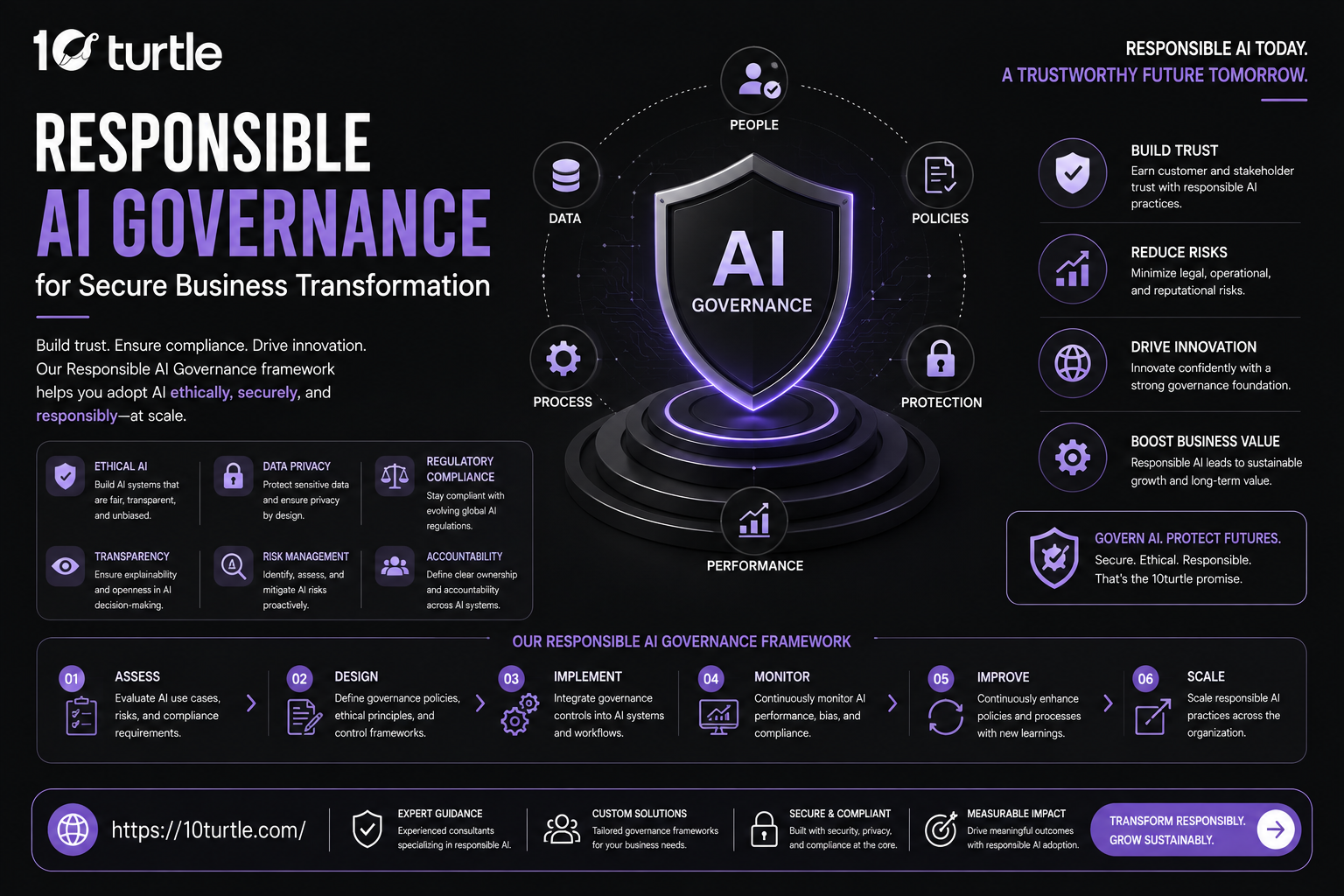
Artificial intelligence has moved from a competitive advantage to an operational necessity for American businesses. From automating customer service to powering predictive analytics, AI now touches nearly every department in the modern enterprise. But with this rapid adoption comes a new set of risks data privacy violations, biased decision-making, security vulnerabilities, and regulatory non-compliance.
This is where responsible AI governance becomes critical. It's no longer enough to simply deploy AI tools; organizations need a structured AI governance strategy that ensures every AI system is secure, ethical, transparent, and aligned with business goals. For companies pursuing digital transformation, governance isn't a roadblock — it's the foundation that makes AI adoption sustainable and trustworthy.
In this guide, we'll break down what responsible AI governance actually means, why it matters for secure business transformation, and how U.S. companies can build a practical framework using established standards like the NIST AI Risk Management Framework.
What Is Responsible AI Governance?
Responsible AI governance refers to the policies, processes, and oversight structures that guide how an organization designs, deploys, and monitors its AI systems. It combines elements of AI ethics and governance, cybersecurity, data privacy, and regulatory compliance into a single operational discipline.
At its core, a strong governance model answers four questions for every AI system in use:
- Is the AI system fair and free from harmful bias?
- Is the data it uses collected, stored, and processed securely?
- Can its decisions be explained and audited?
- Who is accountable if something goes wrong?
Without clear answers to these questions, businesses expose themselves to reputational damage, legal liability, and operational failure — the opposite of what digital transformation is supposed to achieve.
Why Responsible AI Governance Matters for Secure Business Transformation
Digital transformation initiatives increasingly rely on AI to drive efficiency, but speed without structure creates risk. Here's why governance needs to be built into transformation strategy from day one, not added as an afterthought.
1. It protects sensitive business and customer data. AI systems often process large volumes of personal and proprietary information. Without proper oversight, this data can be exposed to breaches, misuse, or non-compliant storage practices — a top concern in any enterprise AI governance program.
2. It reduces legal and regulatory exposure. U.S. businesses are increasingly subject to a patchwork of state and federal AI regulations. Governance frameworks help companies stay ahead of compliance requirements rather than scrambling to react to them.
3. It builds stakeholder trust. Customers, investors, and partners want assurance that AI is being used responsibly. Transparent governance signals maturity and accountability, which strengthens brand reputation.
4. It prevents costly AI failures. Ungoverned AI systems are more likely to produce biased outputs, inaccurate predictions, or security gaps that can derail transformation projects entirely.
The U.S. Regulatory Landscape: What's Changing in 2026
Responsible AI governance in the United States is being shaped by a mix of federal guidance and emerging state legislation, making it essential for businesses to track developments closely rather than assume a single national standard applies.
- NIST AI Risk Management Framework (AI RMF): Developed by the National Institute of Standards and Technology, this voluntary framework has become the de facto standard many U.S. companies use to structure their AI risk management framework. It organizes governance around four functions: Govern, Map, Measure, and Manage.
- State-level AI laws: States such as Colorado and California have introduced AI-specific regulations addressing algorithmic discrimination, automated decision-making, and consumer disclosure requirements. Businesses operating across multiple states need governance policies flexible enough to meet the strictest applicable standard.
- Sector-specific guidance: Industries like healthcare, finance, and insurance face additional oversight from bodies such as the FTC and sector regulators, particularly around automated decision-making that affects consumers.
Because this regulatory environment is still evolving, companies that build governance around a recognized framework like NIST's AI RMF are better positioned to adapt as new rules emerge, rather than rebuilding their compliance process from scratch each time.
Building a Responsible AI Governance Framework: Core Components
A practical AI governance platform or program typically includes the following building blocks:
1. Governance Policy and Ownership
Assign clear accountability — typically a cross-functional AI governance committee involving legal, IT security, data science, and business leadership. Without ownership, even well-designed policies fail in practice.
2. Risk Assessment and Classification
Not all AI use cases carry the same risk. A chatbot answering FAQs poses far less risk than an AI model used for hiring decisions or credit scoring. Classifying systems by risk level allows businesses to apply proportional oversight.
3. Data Governance and Security Controls
Since AI is only as trustworthy as the data behind it, this component ties directly into broader enterprise AI security practices — encryption, access controls, data minimization, and secure data pipelines.
4. Bias Testing and Explainability
Regular audits should evaluate whether AI outputs disproportionately affect any group unfairly. Explainability tools help teams understand why an AI system reached a particular decision, which is essential for both compliance and internal trust.
5. Continuous Monitoring and Documentation
Governance isn't a one-time checklist. AI systems evolve, and so do the risks. Ongoing monitoring, audit trails, and documented decision logs support both responsible AI implementation and long-term regulatory readiness.
Responsible AI Governance Best Practices for U.S. Businesses
- Start with an AI inventory — you can't govern what you haven't mapped.
- Align your framework to NIST AI RMF functions rather than building policy from scratch.
- Involve legal and compliance teams early in AI procurement decisions, not after deployment.
- Set clear escalation paths for flagged AI risks or incidents.
- Train employees across departments on responsible AI use, not just technical teams.
- Review and update governance policies quarterly as regulations and AI capabilities evolve.
These AI governance best practices aren't just about avoiding penalties — they create the operational discipline that makes secure, scalable business transformation possible.
How Governance Enables — Not Slows — Transformation
A common misconception is that governance slows innovation. In reality, the opposite tends to be true. Companies with mature governance structures can adopt new AI tools faster because approval pathways, risk assessments, and security reviews are already standardized. Instead of every new AI initiative requiring a ground-up risk evaluation, governed organizations can plug new use cases into an existing framework.
This is the real value of a well-designed AI governance strategy: it turns responsible AI from a compliance burden into a competitive advantage, giving businesses the confidence to scale AI adoption securely across departments, markets, and customer touchpoints.
Conclusion
Responsible AI governance isn't optional for businesses serious about digital transformation — it's the framework that makes transformation secure, sustainable, and trustworthy. By grounding your approach in established standards like the NIST AI RMF, staying current with evolving state regulations, and embedding accountability across your organization, you position your business to adopt AI confidently rather than cautiously.
Companies that treat governance as a strategic enabler — not a checkbox — will be the ones best equipped to lead their industries through the next phase of AI-driven transformation.
Frequently Asked Questions
Why is AI governance important for businesses?
AI governance is important because it protects businesses from legal, security, and reputational risks while ensuring AI systems operate fairly, transparently, and in line with company values. It also builds the trust needed for customers and stakeholders to embrace AI-driven products and services.
How do I implement AI governance in my organization?
Start by inventorying all AI systems in use, classifying them by risk level, and forming a cross-functional governance committee. From there, align your policies with a recognized framework such as the NIST AI Risk Management Framework, and implement ongoing monitoring, documentation, and employee training.
What percentage of companies have a formal AI governance program?
Adoption is growing quickly but remains uneven — many organizations have begun AI initiatives without a formal governance structure in place, which is why frameworks like NIST's AI RMF have seen rising adoption as companies work to close that gap.
How should CISOs approach AI governance?
Chief Information Security Officers should treat AI governance as an extension of existing cybersecurity and risk management programs — integrating AI-specific risks like model security, data leakage, and adversarial attacks into the organization's broader security posture rather than managing AI as a separate silo.
What happens if a company doesn't have AI governance in place?
Without governance, businesses risk deploying biased or non-compliant AI systems, exposing sensitive data, facing regulatory penalties, and losing customer trust — all of which can significantly disrupt or derail digital transformation efforts.
Is AI governance only relevant for large enterprises?
No. While large enterprises often move first due to regulatory exposure, small and mid-sized businesses adopting AI tools face the same risks around data privacy, bias, and compliance — making a scaled-down governance approach valuable at any company size.
- Business
- Technology
- Finance
- Health
- Fashion
- Lifestyle
- Travel
- Food
- Education
- Real Estate
- Automobile
- Entertainment
- Sports
- Pets
- Home Decor
- Gardening
- Parenting
- Wedding
- Beauty
- Gaming
- Photography
- Music
- Movies
- News
- Politics
- Religion
- Astrology
- Law
- Insurance
- Jobs
- Freelancing
- Remote Work
- Blogging
- E-commerce
- WordPress
- OpenCart
- Social Media
- Graphic Design
- Web Design
- Programming
- Mobile Apps
- Artificial Intelligence
- SaaS
- Cyber Security
- Cloud Computing
- Hosting
- SEO
- Content Writing
- Email Marketing
- Affiliate Marketing
- YouTube
- Podcasting
- Interior Design
- DIY
- Crafts
- Art
- Architecture
- Environment
- Agriculture
- Animals
- Fishing
- Hunting
- Survival
- Outdoor
- Fitness
- Yoga
- Meditation
- Mental Health
- Skin Care
- Hair Care
- Makeup
- Jewelry
- Sarees
- Salwar Kameez
- Lehenga Choli
- Kurtis
- Men Fashion
- Women Fashion
- Kids Fashion
- Footwear
- Bags
- Watches
- Luxury
- Shopping
- Coupons
- Electronics
- Smartphones
- Laptops
- Tablets
- Cameras
- Home Appliances
- Kitchen
- Furniture
- Cleaning
- Baby Care
- Senior Care
- Relationships
- Self Improvement
- Motivation
- Quotes
- Festivals
- Events
- Careers
- Remote Work
- Productivity
- Wholesale
- Manufacturing
- Import Export
- Logistics
- Supply Chain
- Human Resources
- Customer Service
