
Hybrid Resource Model: Combining On-Site Management With Offshore Talent
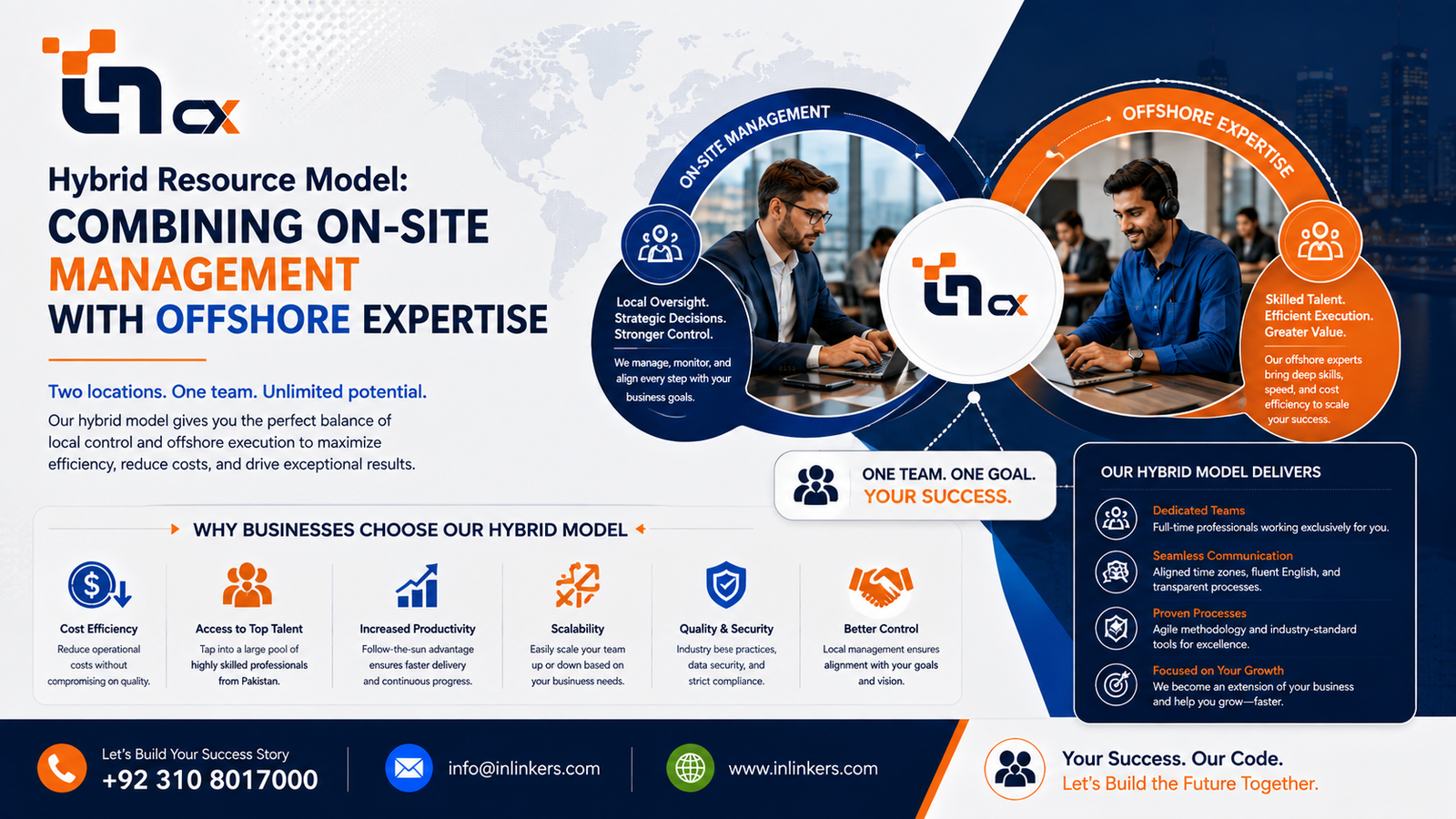
Businesses today need to balance three important priorities: access to skilled professionals, operational control and cost efficiency. Traditional in-house teams can provide strong visibility and communication, but they can also become expensive as organizations add developers, analysts, support agents, designers and other specialists.
Fully offshore teams can reduce operating costs and provide access to international talent, but some businesses may be concerned about communication gaps, project visibility and coordination.
A hybrid resource model combines the advantages of both approaches. The model places a project manager or key representative on-site while the broader delivery team operates from an offshore location. InLinkers CX describes its hybrid resource model as an on-site project manager working in the client's time zone while the full delivery team works from its Pakistan operations center.
What Is a Hybrid Resource Model?
A hybrid resource model is a workforce structure that combines on-site and offshore professionals within one delivery team.
Instead of choosing between a completely local workforce and a fully offshore operation, businesses can divide responsibilities between locations.
For example, a technology company may have:
-
An on-site project manager
-
Software developers in Pakistan
-
QA engineers in Pakistan
-
A DevOps specialist offshore
-
A data analyst offshore
-
Designers or support specialists offshore
The on-site manager becomes the communication bridge between the client and the offshore delivery team.
This structure can provide businesses with direct project visibility while allowing them to access offshore talent at competitive operating costs.
How the Hybrid Model Works
The basic concept is straightforward.
The client has a dedicated manager or project representative working directly with its local team. The larger delivery operation works from an offshore location.
The on-site manager can participate in meetings, understand business requirements, coordinate priorities, communicate with stakeholders and monitor progress.
The offshore team handles the majority of development or operational work.
According to InLinkers CX, its model places the project manager at the client's office while the delivery team operates from its Lahore, Pakistan operations center.
This creates a structure where management remains close to the client while execution can benefit from offshore resources.
Why Businesses Are Choosing Hybrid Resources
Companies increasingly need flexible ways to scale their workforce.
Hiring every employee locally can increase costs associated with recruitment, salaries, benefits, office space, equipment and training. At the same time, completely offshore operations may not suit businesses that require close collaboration.
The hybrid model addresses this gap.
Businesses can keep critical management and communication functions close to their operations while using offshore professionals for delivery.
Potential advantages include:
-
Better communication
-
Greater project visibility
-
Flexible staffing
-
Access to specialized talent
-
Lower operational costs
-
Faster scaling
-
Dedicated project management
-
Continuous delivery support
The exact benefits depend on the team structure, location, roles and engagement agreement.
On-Site Project Management
One of the most important elements of a hybrid model is the on-site project manager.
The project manager works directly with the client's organization and can participate in daily meetings, planning sessions, reviews and decision-making.
This can help reduce communication delays.
The manager can:
-
Understand business objectives
-
Coordinate project priorities
-
Track deadlines
-
Communicate requirements
-
Monitor offshore resources
-
Resolve operational issues
-
Report project progress
-
Coordinate stakeholder communication
InLinkers CX states that its on-site project manager joins the client's meetings and communication channels while acting as the bridge between the business and offshore delivery team.
Offshore Delivery Team
The offshore component provides the majority of specialized resources.
Depending on the project, this team can include:
-
Software developers
-
Full-stack developers
-
Mobile developers
-
AI/ML engineers
-
DevOps engineers
-
QA engineers
-
Data analysts
-
Designers
-
Call center agents
-
Finance professionals
-
Healthcare BPO specialists
InLinkers CX's hybrid model supports different types of delivery resources, including developers, billers, call center agents and designers.
This makes the model useful beyond traditional software development.
Hybrid Resources for IT Projects
Technology companies can use hybrid teams to support software development and IT operations.
A typical team could include an on-site project manager supported by offshore:
-
Front-end developers
-
Back-end developers
-
Mobile developers
-
QA engineers
-
Cloud engineers
-
Database specialists
The local manager communicates requirements while the offshore team handles technical execution.
This can be particularly useful for companies working on long-term applications that require continuous development, testing, maintenance and support.
Hybrid Resources for BPO Operations
The hybrid model can also be applied to business process outsourcing.
A company may have an on-site operations manager while offshore teams handle:
-
Customer support
-
Technical support
-
Data entry
-
Finance and accounting
-
Insurance processing
-
Mortgage support
-
Healthcare back-office operations
-
Lead generation
This allows the client to maintain local operational oversight while leveraging offshore staffing capacity.
Cost Efficiency
One of the main reasons businesses consider hybrid resources is cost management.
A fully on-site team requires every employee to be hired and maintained locally. For businesses operating in high-cost markets, this can significantly increase workforce expenses.
A hybrid structure places only selected roles on-site while the larger team operates offshore.
InLinkers CX promotes its hybrid model as offering approximately 60% lower costs than fully on-site delivery, although actual savings depend on team composition and project requirements.
Businesses should evaluate the complete cost structure rather than focusing only on individual salaries. Recruitment, infrastructure, technology, management, benefits and employee turnover can all affect total workforce costs.
Better Communication Between Teams
Communication is one of the most important factors in outsourcing success.
Fully offshore teams can sometimes experience challenges when requirements are unclear or when stakeholders are separated by geography and time zones.
A hybrid model introduces an on-site representative who can communicate directly with the client.
The project manager can translate business requirements into actionable instructions for the offshore team and provide updates to local stakeholders.
This can help reduce misunderstandings and improve coordination.
Improved Project Visibility
Businesses often want clear visibility into what their outsourced teams are working on.
A hybrid structure can provide greater transparency through an on-site manager who monitors progress and communicates regularly with stakeholders.
Performance can be measured through:
-
Project milestones
-
Sprint completion
-
Quality metrics
-
Response times
-
Team utilization
-
Delivery timelines
-
Customer satisfaction
-
Issue resolution
InLinkers CX states that its hybrid model includes weekly KPI reporting covering areas such as output, quality, turnaround times and team utilization.
Faster Team Scaling
Business requirements can change quickly.
A company may start with five developers and later need ten. A customer support operation may need additional agents during seasonal demand. A software project may require additional QA resources before launch.
A hybrid model can make scaling easier because the offshore component can be expanded without requiring the client to recruit every employee locally.
InLinkers CX states that its hybrid teams can scale offshore resources within approximately 7–14 days, depending on requirements and available talent.
Built-In Backup Resources
Another potential advantage of an organized offshore operation is resource continuity.
Businesses can face operational disruption when an individual employee leaves or becomes unavailable.
A structured outsourcing provider can maintain backup resources and documentation to reduce dependency on a single individual.
InLinkers CX states that its hybrid model includes identified trained backup resources for offshore team members.
This approach can help maintain continuity for projects where uninterrupted delivery is important.
Security and Confidentiality
Security should be considered carefully when working with remote and offshore teams.
Businesses should establish appropriate controls for:
-
User permissions
-
Data access
-
Confidential information
-
Password management
-
Device security
-
System access
-
Intellectual property
-
Documentation
-
Employee onboarding and offboarding
InLinkers CX states that its hybrid model uses company-level NDAs and additional confidentiality and IP agreements for relevant personnel.
Companies should also conduct their own security and compliance assessment based on industry requirements and the type of data being handled.
Hybrid Resources Across Different Industries
The hybrid model can support businesses in many sectors.
Technology
Software development, QA, DevOps, cloud management and technical support can be delivered through hybrid teams.
Healthcare
Healthcare organizations can use offshore teams for approved administrative and back-office functions while maintaining local management.
Finance
Accounting, bookkeeping, financial analysis and data processing can be supported through offshore specialists.
Insurance
Insurance businesses can use hybrid teams for claims processing, policy administration, data management and customer support.
E-Commerce
E-commerce businesses can combine local management with offshore customer service, technical support, data processing and development resources.
Professional Services
Agencies and professional service firms can use hybrid resources for research, administration, development, design and support functions.
How to Implement a Hybrid Resource Model
A successful hybrid operation requires structured planning.
Step 1: Define Your Requirements
Identify the functions you want to keep on-site and the activities that can be handled offshore.
Step 2: Determine Team Structure
Decide how many on-site managers and offshore specialists are required.
Step 3: Establish Responsibilities
Clearly define the responsibilities of the client, project manager and offshore team.
Step 4: Set Communication Processes
Create regular meetings, reporting procedures, project-management workflows and escalation processes.
Step 5: Establish KPIs
Define measurable objectives for quality, productivity, turnaround time, project progress and customer satisfaction.
Step 6: Begin Operations
On-site and offshore teams should be introduced to the company's processes, tools, systems and expectations.
Step 7: Monitor and Scale
Review performance regularly and adjust the team according to changing business requirements.
Hybrid vs. Fully On-Site
A fully on-site model provides maximum physical presence but can be expensive and difficult to scale.
A hybrid model keeps critical management functions close to the client while using offshore resources for delivery.
This can provide a balance between:
-
Control
-
Communication
-
Cost
-
Scalability
-
Access to talent
For businesses that require direct management but want to control workforce costs, hybrid resources can be a practical option.
Hybrid vs. Fully Offshore
Fully offshore operations can provide significant cost advantages and access to global talent.
However, businesses may need additional communication and management processes.
A hybrid model adds an on-site manager who can coordinate directly with the client.
This makes hybrid resources particularly useful for companies that want offshore delivery without completely separating their management and communication functions.
Why Choose InLinkers CX for Hybrid Resources?
InLinkers CX provides a hybrid resource model designed to combine on-site project management with Pakistan-based offshore delivery.
The company states that its model is available across six regions: the United States, United Kingdom, Australia, UAE, Saudi Arabia and Canada.
Its stated process includes discovery and requirements gathering, NDA and proposal preparation, client interviews and resource approval, on-site project manager deployment, offshore team onboarding and ongoing KPI reporting.
This structured approach can help businesses establish a hybrid team while maintaining visibility over staffing, delivery, performance and communication.
Final Thoughts
The hybrid resource model offers businesses a middle ground between fully local teams and completely offshore operations.
By combining an on-site project manager with an offshore delivery team, companies can maintain direct communication and operational visibility while accessing international talent and potentially reducing workforce costs.
The model can support technology projects, customer service, healthcare BPO, finance, insurance, data management and other business functions.
For organizations looking to scale efficiently without sacrificing management control, hybrid resources can provide a flexible workforce strategy.
With clear responsibilities, strong communication, measurable KPIs, appropriate security controls and the right outsourcing partner, a hybrid team can become an extension of the internal organization rather than simply an external vendor.
- Business
- Technology
- Finance
- Health
- Fashion
- Lifestyle
- Travel
- Food
- Education
- Real Estate
- Automobile
- Entertainment
- Sports
- Pets
- Home Decor
- Gardening
- Parenting
- Wedding
- Beauty
- Gaming
- Photography
- Music
- Movies
- News
- Politics
- Religion
- Astrology
- Law
- Insurance
- Jobs
- Freelancing
- Remote Work
- Blogging
- E-commerce
- WordPress
- OpenCart
- Social Media
- Graphic Design
- Web Design
- Programming
- Mobile Apps
- Artificial Intelligence
- SaaS
- Cyber Security
- Cloud Computing
- Hosting
- SEO
- Content Writing
- Email Marketing
- Affiliate Marketing
- YouTube
- Podcasting
- Interior Design
- DIY
- Crafts
- Art
- Architecture
- Environment
- Agriculture
- Animals
- Fishing
- Hunting
- Survival
- Outdoor
- Fitness
- Yoga
- Meditation
- Mental Health
- Skin Care
- Hair Care
- Makeup
- Jewelry
- Sarees
- Salwar Kameez
- Lehenga Choli
- Kurtis
- Men Fashion
- Women Fashion
- Kids Fashion
- Footwear
- Bags
- Watches
- Luxury
- Shopping
- Coupons
- Electronics
- Smartphones
- Laptops
- Tablets
- Cameras
- Home Appliances
- Kitchen
- Furniture
- Cleaning
- Baby Care
- Senior Care
- Relationships
- Self Improvement
- Motivation
- Quotes
- Festivals
- Events
- Careers
- Remote Work
- Productivity
- Wholesale
- Manufacturing
- Import Export
- Logistics
- Supply Chain
- Human Resources
- Customer Service
