
How does a Laminar Airflow System Setup Company design and install laminar airflow systems?
INTRODUCTION
A Laminar Airflow System Setup Company designs and installs controlled airflow systems to create cleaner, more predictable environments for applications where airborne particulate control is important. The process involves much more than installing a filtration unit. It requires application assessment, room planning, airflow calculations, equipment selection, HEPA filtration, HVAC integration, installation, testing, commissioning, and preventive maintenance. A properly engineered system should be designed around the specific room, process, equipment, occupancy, and applicable performance requirements.
Laminar airflow systems are used across healthcare, pharmaceutical, biotechnology, laboratory, electronics, research, and other controlled environments. Depending on the application, the airflow may be arranged vertically or horizontally. The objective is generally to deliver highly filtered air in a controlled direction across a defined work area while limiting unwanted turbulence and particulate accumulation.
What Is a Laminar Airflow System?
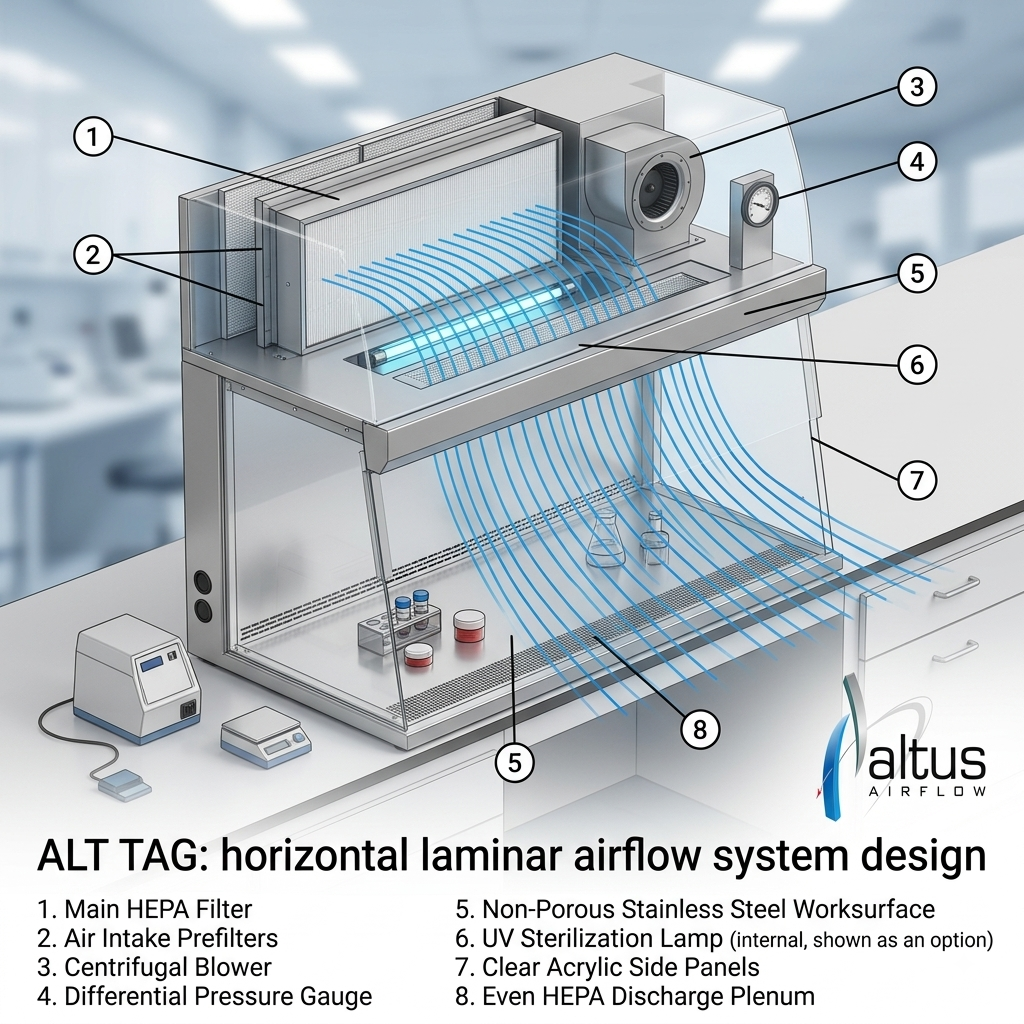
A laminar airflow system is an engineered air-distribution arrangement intended to provide relatively uniform, controlled airflow through a designated area.
A typical system may contain:
- Air-handling equipment
- Pre-filters
- HEPA filters
- Blower or fan assembly
- Supply-air plenum
- Air distribution section
- Control system
- Monitoring instruments
- Supporting ductwork where applicable
The exact configuration depends on whether the system is being installed as a standalone unit, integrated into a cleanroom, or incorporated into a larger HVAC system.
Why Professional Design Is Important
Airflow performance depends on several interacting factors.
These include:
- Room dimensions
- Airflow volume
- Air velocity
- Filter efficiency
- Equipment layout
- Heat loads
- Occupancy
- Pressure relationships
- Return-air arrangement
- Required cleanliness level
A system that is correctly sized but poorly positioned may not produce the desired airflow pattern.
Professional engineering therefore starts with the application rather than simply selecting a standard fan and filter.
1. Understanding the Client's Application
The first stage is understanding what the system needs to accomplish.
The design team may ask:
- What process will occur in the controlled area?
- What cleanliness level is required?
- What room dimensions are available?
- How many people will occupy the area?
- What equipment will be installed?
- Is the system standalone or part of a cleanroom?
- What temperature and humidity conditions are required?
- What monitoring is necessary?
This information forms the basis of the engineering design.
2. Conducting a Site Survey
A site survey helps identify practical installation requirements.
Engineers may assess:
- Room dimensions
- Ceiling height
- Existing HVAC systems
- Electrical capacity
- Available service space
- Structural conditions
- Duct routes
- Equipment locations
- Access for installation
- Maintenance requirements
For existing facilities, the survey is particularly important because existing services may affect the final design.
3. Defining the Airflow Pattern
The airflow direction is selected according to the application.
Two common configurations are:
Vertical Airflow
Filtered air moves downward from the upper section toward the work area.
Horizontal Airflow
Filtered air moves horizontally across the controlled work zone.
The selection depends on:
- Process requirements
- Equipment arrangement
- Room configuration
- Contamination-control objectives
- Available space
The airflow pattern should be determined during engineering rather than after installation.
4. Performing Airflow Calculations
Airflow calculations determine the required air volume and distribution.
Engineers may consider:
- Room dimensions
- Desired airflow velocity
- Required air changes
- Filter face area
- Pressure drop
- Fan capacity
- Occupancy
- Equipment heat loads
Correct calculations help prevent both under-designed and unnecessarily oversized systems.
5. Selecting the Appropriate HEPA Filters
HEPA filtration is a central component of many laminar airflow systems.
Filter selection should consider:
- Required efficiency
- Filter dimensions
- Pressure drop
- Airflow volume
- Housing design
- Sealing arrangement
- Testing requirements
The filter must be installed correctly to prevent bypass around the filtration media.
6. Selecting Pre-Filtration
Pre-filters can protect downstream HEPA filters by capturing larger particles before the air reaches the final filtration stage.
Depending on the system, multiple filtration stages may be used.
Pre-filtration can help:
- Reduce HEPA loading
- Extend filter service life
- Protect blower components
- Improve overall filtration performance
The filtration sequence should be selected according to the application and manufacturer's specifications.
7. Designing the Air Plenum
The plenum distributes air across the filter surface.
A well-designed plenum helps provide more uniform airflow across the working area.
Engineering considerations include:
- Plenum dimensions
- Air inlet location
- Internal pressure distribution
- Filter arrangement
- Access for maintenance
Poor plenum design can create uneven airflow even when the fan has sufficient capacity.
8. Selecting the Fan or Blower
The blower must provide the required airflow against the total system resistance.
Pressure losses may come from:
- Pre-filters
- HEPA filters
- Ductwork
- Dampers
- Grilles
- Plenums
- Other components
The fan should therefore be selected based on both airflow and static pressure requirements.
9. Designing the Supporting HVAC System
In larger installations, the laminar airflow system may be connected to an HVAC system.
The HVAC design may manage:
- Fresh air
- Recirculated air
- Temperature
- Humidity
- Pressure
- Air changes
- Filtration
This is especially important in cleanrooms and healthcare environments where environmental conditions must remain stable.
10. Planning Room Layout
The airflow system must be coordinated with the physical room.
Designers should consider:
- Workstations
- Operating tables
- Laboratory equipment
- Machinery
- Storage
- Doors
- Personnel movement
- Return-air locations
Large objects can interfere with airflow and create turbulence.
11. Selecting Appropriate Installation Materials
Depending on the application, the installation may use:
- Powder-coated panels
- Stainless steel
- Insulated panels
- Aluminum components
- Hygienic ceiling systems
- Sealed ductwork
- Specialized filter housings
Material selection should consider cleanliness, durability, corrosion resistance, maintenance, and compatibility with the operating environment.
12. Electrical and Control Integration
The system may require:
- Power supply
- Control panels
- Fan controls
- Variable-speed drives
- Differential-pressure indicators
- Alarm systems
- Monitoring sensors
Control integration allows operators to monitor system performance and adjust operating parameters where appropriate.
13. Installation of the Supporting Structure
Before installing the airflow equipment, the installation team prepares the supporting structure.
This may involve:
- Ceiling supports
- Equipment frames
- Filter housings
- Duct supports
- Service access
- Sealing systems
Structural support must be adequate for the installed equipment.
14. Installing the Filtration System
The installation team then fits the filtration components.
Typical sequence may involve:
- Pre-filter installation
- Blower installation
- Plenum connection
- HEPA filter installation
- Sealing
- Electrical connection
- Control-system connection
Filter installation requires careful handling to prevent damage.
15. Sealing and Leakage Control
Air leakage can compromise system performance.
Potential leakage points include:
- Filter frames
- Duct joints
- Panel joints
- Access doors
- Plenum connections
Appropriate sealing procedures help ensure that air passes through the intended filtration path rather than bypassing it.
16. Integrating Return Air
The return-air arrangement is an important part of airflow management.
Return-air locations should be selected according to the intended airflow pattern.
Poor return-air positioning can disrupt the desired airflow direction.
In a larger cleanroom, return-air paths also contribute to room pressure relationships and overall air circulation.
17. Testing Airflow Velocity
After installation, airflow velocity should be measured at appropriate locations.
Testing can identify:
- Uneven airflow
- Insufficient airflow
- Excessive velocity
- Blockages
- Fan-performance issues
Measurements should be compared with the project's specified acceptance criteria.
18. HEPA Filter Integrity Testing
HEPA filters should be tested after installation according to the applicable testing protocol.
Integrity testing can help identify:
- Filter damage
- Seal problems
- Leakage
- Installation defects
This is an important part of commissioning systems where high-efficiency filtration is required.
19. Airflow Visualization
Airflow visualization can help demonstrate the direction and behavior of airflow.
Depending on the application, visualization techniques may be used to identify:
- Turbulence
- Dead zones
- Backflow
- Unexpected air movement
This can be particularly useful when equipment or room geometry is complex.
20. Particle Monitoring
Particle measurements can help assess the cleanliness performance of a controlled area.
Testing may evaluate particle concentrations at specified particle sizes according to the applicable requirements.
Particle testing should be performed under defined conditions so that results can be interpreted consistently.
21. Pressure Differential Testing
Where the laminar airflow system is part of a controlled cleanroom environment, pressure relationships may need to be verified.
Pressure testing helps determine whether air is moving between rooms in the intended direction.
This is particularly relevant when multiple cleanliness zones are connected.
22. Temperature and Humidity Verification
For systems integrated with HVAC, temperature and humidity should also be checked.
Stable environmental conditions can be important for:
- Personnel comfort
- Process stability
- Equipment operation
- Material protection
The acceptable range depends on the application.
23. Commissioning and Documentation
A professional installation should conclude with commissioning and documentation.
Documentation may include:
- Equipment specifications
- Filter details
- Test reports
- Airflow measurements
- Pressure readings
- Commissioning records
- Maintenance instructions
- As-built information
Good documentation helps facility teams operate and maintain the system correctly.
24. Staff Training
Operators should understand:
- Start-up procedures
- Shutdown procedures
- Alarm conditions
- Filter monitoring
- Cleaning requirements
- Basic troubleshooting
- Maintenance schedules
Training helps reduce operational errors and supports long-term performance.
25. Preventive Maintenance
A laminar airflow system requires ongoing maintenance after installation.
Maintenance may include:
- Pre-filter inspection
- Pre-filter replacement
- HEPA filter monitoring
- Fan inspection
- Motor maintenance
- Airflow measurement
- Pressure monitoring
- Cleaning
- Electrical inspection
The maintenance frequency should be established according to system usage, environmental conditions, manufacturer recommendations, and measured performance.
26. What Can Affect Installation Time?
Installation duration depends on:
- System size
- Number of units
- Room preparation
- HVAC integration
- Ductwork
- Electrical work
- Filter availability
- Customization
- Site access
- Testing requirements
A small standalone unit can require significantly less installation work than a complete cleanroom airflow system.
27. Benefits of Professional Laminar Airflow Installation
A properly engineered and installed system can provide:
- Controlled airflow
- High-efficiency filtration
- Better particulate management
- More predictable environmental conditions
- Improved process protection
- Easier monitoring
- Better maintenance planning
- Greater system reliability
Performance depends on correct design, installation, commissioning, and ongoing maintenance.
28. Applications of Laminar Airflow Systems
Laminar airflow systems may be used in:
- Pharmaceutical manufacturing
- Biotechnology
- Healthcare
- IVF laboratories
- Research laboratories
- Electronics manufacturing
- Medical-device manufacturing
- Food and specialized processing
- Laboratory environments
Each application requires a design appropriate to its specific contamination-control and environmental requirements.
29. How to Select a Setup Company
Organizations should evaluate prospective providers based on:
- Engineering experience
- Cleanroom expertise
- HVAC knowledge
- Filtration experience
- Airflow testing capabilities
- Commissioning procedures
- Documentation
- Maintenance support
- Project management
It is useful to request project references and technical documentation before making a decision.
30. Why Design and Installation Should Be Treated as One Process
Separating design from installation can create coordination problems.
A provider responsible for both stages can maintain continuity between:
Application Assessment → Engineering → Equipment Selection → Manufacturing → Installation → Testing → Commissioning
This integrated approach can reduce design-to-installation discrepancies and improve project coordination.
Conclusion
A Laminar Airflow System Setup Company designs and installs laminar airflow systems through a structured process involving application assessment, site surveys, airflow calculations, airflow-pattern selection, HEPA and pre-filter selection, blower sizing, HVAC integration, room-layout coordination, installation, sealing, testing, commissioning, and maintenance planning. The objective is not simply to move air through a filter but to create a controlled airflow environment suited to the specific application. Proper installation, validation, monitoring, and preventive maintenance are essential for maintaining long-term performance. For organizations seeking specialized laminar airflow, cleanroom, HVAC, and controlled-environment engineering solutions, Altus Airflow provides project-focused expertise from design through installation and commissioning.
Frequently Asked Questions
1. How does a Laminar Airflow System Setup Company design a laminar airflow system?
A Laminar Airflow System Setup Company begins by evaluating the application, room dimensions, cleanliness requirements, equipment, occupancy, airflow pattern, filtration requirements, HVAC conditions, and applicable performance criteria before developing the engineering design.
2. What components are included in a laminar airflow system?
A Laminar Airflow System Setup Company may provide components such as pre-filters, HEPA filters, blowers, plenums, airflow distribution systems, controls, monitoring instruments, and supporting HVAC or ductwork depending on the project.
3. Why are HEPA filters important?
HEPA filters provide high-efficiency removal of airborne particles. A Laminar Airflow System Setup Company selects and installs filters according to airflow volume, pressure drop, application requirements, and specified filtration performance.
4. How is airflow velocity determined?
A Laminar Airflow System Setup Company considers the application, filter face area, required airflow volume, room configuration, and project specifications when determining the appropriate airflow velocity.
5. Does a laminar airflow system require HVAC integration?
Not always. Some systems operate as standalone units, while others are integrated with larger HVAC and cleanroom systems. A Laminar Airflow System Setup Company determines the appropriate arrangement based on the application.
Read Our Previous Blog------>How does IVF Laboratory Design optimize laboratory workflow and space utilization?
- Business
- Technology
- Finance
- Health
- Fashion
- Lifestyle
- Travel
- Food
- Education
- Real Estate
- Automobile
- Entertainment
- Sports
- Pets
- Home Decor
- Gardening
- Parenting
- Wedding
- Beauty
- Gaming
- Photography
- Music
- Movies
- News
- Politics
- Religion
- Astrology
- Law
- Insurance
- Jobs
- Freelancing
- Remote Work
- Blogging
- E-commerce
- WordPress
- OpenCart
- Social Media
- Graphic Design
- Web Design
- Programming
- Mobile Apps
- Artificial Intelligence
- SaaS
- Cyber Security
- Cloud Computing
- Hosting
- SEO
- Content Writing
- Email Marketing
- Affiliate Marketing
- YouTube
- Podcasting
- Interior Design
- DIY
- Crafts
- Art
- Architecture
- Environment
- Agriculture
- Animals
- Fishing
- Hunting
- Survival
- Outdoor
- Fitness
- Yoga
- Meditation
- Mental Health
- Skin Care
- Hair Care
- Makeup
- Jewelry
- Sarees
- Salwar Kameez
- Lehenga Choli
- Kurtis
- Men Fashion
- Women Fashion
- Kids Fashion
- Footwear
- Bags
- Watches
- Luxury
- Shopping
- Coupons
- Electronics
- Smartphones
- Laptops
- Tablets
- Cameras
- Home Appliances
- Kitchen
- Furniture
- Cleaning
- Baby Care
- Senior Care
- Relationships
- Self Improvement
- Motivation
- Quotes
- Festivals
- Events
- Careers
- Remote Work
- Productivity
- Wholesale
- Manufacturing
- Import Export
- Logistics
- Supply Chain
- Human Resources
- Customer Service
