
Regulatory Affairs and Pharmacovigilance in Indonesia: A Lifecycle Approach for Pharma Companies
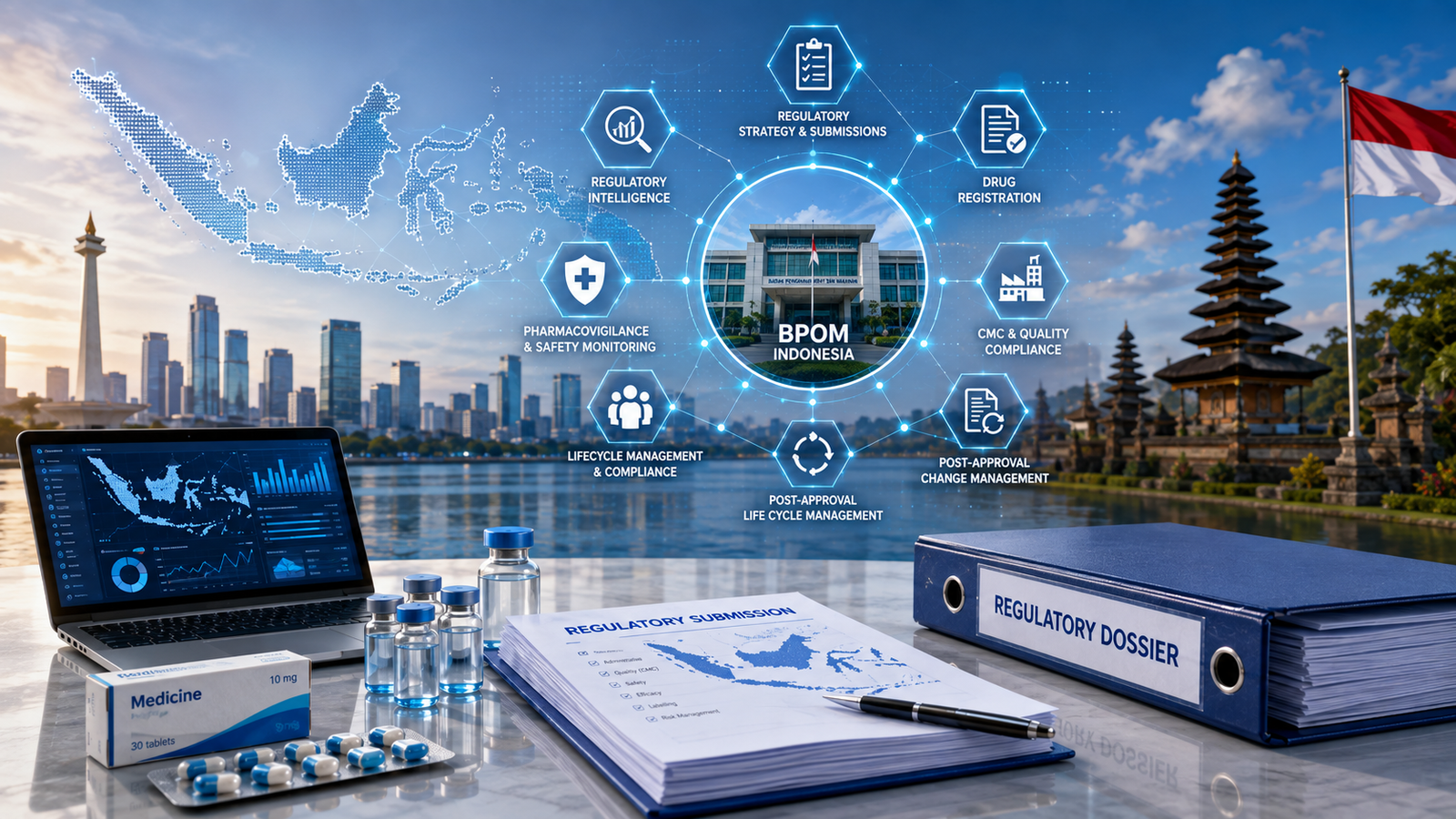
Regulatory Affairs and Pharmacovigilance in Indonesia
Introduction
Indonesia is one of Southeast Asia's most important pharmaceutical markets, but entering and maintaining a product in the market requires more than completing an initial registration.
For pharmaceutical companies, regulatory affairs and pharmacovigilance in Indonesia are connected throughout the product lifecycle. Regulatory strategy influences how a product is registered, while post-market safety information can lead to regulatory assessments, product-information changes, variations, risk-management activities, or other actions.
The regulatory environment is also evolving. In February 2026, the Indonesian Food and Drug Authority, or BPOM, issued Peraturan BPOM Nomor 4 Tahun 2026 tentang Pelaksanaan Farmakovigilans. The regulation is currently in force and revoked the previous PerBPOM No. 15 Tahun 2022 on pharmacovigilance.
For global pharmaceutical organizations, this reinforces an important principle: regulatory compliance should be managed as a continuous lifecycle rather than as a series of disconnected submissions.
Companies entering the Indonesian market therefore need a coordinated approach covering regulatory strategy, registration, CMC, post-approval changes, pharmacovigilance, regulatory intelligence, and ongoing compliance.
Understanding Regulatory Affairs in Indonesia
Regulatory affairs is responsible for helping a pharmaceutical organization navigate applicable regulatory requirements from development through commercialization and beyond.
In Indonesia, BPOM is the central authority responsible for the regulation and oversight of medicines and other products within its mandate.
The official BPOM Directorate of Drug Registration portal provides information and consultation related to drug registration in Indonesia, including services for stakeholders and industry.
A regulatory affairs function may therefore be involved in:
- Regulatory pathway assessment
- Registration strategy
- Dossier preparation
- Submission management
- Regulatory correspondence
- CMC documentation
- Product information
- Variation submissions
- Renewal activities
- Post-approval commitments
- Regulatory intelligence
- Health authority interactions
For companies without an established local regulatory infrastructure, Regulatory Services in Indonesia can be considered as part of a broader market-entry and compliance framework.
The key is to view local regulatory support as an extension of the company's overall regulatory strategy rather than as a standalone filing activity.
Why Regulatory Affairs and Pharmacovigilance Must Work Together
Regulatory affairs and pharmacovigilance have different operational responsibilities, but their outputs frequently overlap.
Consider a simplified example.
A pharmacovigilance team identifies new safety information associated with a marketed product. The finding may require further evaluation. If the assessment confirms a meaningful regulatory impact, the organization may need to consider reporting, risk-management measures, changes to product information, or a regulatory submission.
This creates a chain:
Safety information → Assessment → Regulatory impact → Action → Documentation
The same principle works in the opposite direction.
A regulatory authority may request additional safety information or require changes to product information. Regulatory teams then need to communicate those changes to pharmacovigilance, medical, quality and other relevant functions.
This is why a mature RA/PV model should establish clear interfaces between:
- Safety surveillance
- Regulatory reporting
- Product information
- Risk management
- Regulatory submissions
- Quality systems
- Medical affairs
- Regulatory intelligence
The Indonesian Drug Registration Lifecycle
A successful Indonesian regulatory strategy begins well before submission.
1. Regulatory pathway assessment
Companies should first determine the appropriate registration pathway and understand the evidence expected for the relevant product category.
Important considerations may include:
- Product type
- Active pharmaceutical ingredient
- Dosage form
- Strength
- Indication
- Manufacturing arrangements
- Supporting clinical evidence
- Quality documentation
- Product information
- Local regulatory requirements
BPOM's Directorate of Drug Registration maintains an official registration portal for information and consultation concerning drug registration.
2. Dossier preparation
A regulatory dossier needs to present scientific, quality, safety and administrative information in a coherent manner.
Poor document control can create avoidable problems even when the underlying scientific package is strong.
Regulatory teams should therefore establish controls for:
- Document versioning
- Source-data traceability
- Submission readiness
- Regulatory commitments
- Product information
- Supporting evidence
- Response management
3. Regulatory review
After submission, companies may need to respond to requests for additional information or clarification.
This makes regulatory project management important.
A strong process should define:
- Question ownership
- Response timelines
- Cross-functional review
- Scientific evidence requirements
- Final approval
- Submission tracking
- Regulatory correspondence
BPOM's published service standards describe its objective of providing professional, transparent, objective, effective and accountable public services for stakeholders involved in drug registration.
CMC Considerations in Regulatory Submissions
Chemistry, Manufacturing and Controls, commonly referred to as CMC, is a critical part of pharmaceutical regulatory strategy.
CMC information demonstrates that a product can consistently meet appropriate quality requirements.
Depending on the product and regulatory pathway, CMC considerations can include:
- Active pharmaceutical ingredient information
- Manufacturing processes
- Manufacturing sites
- Specifications
- Analytical methods
- Stability data
- Packaging
- Batch information
- Process controls
- Quality systems
- Changes to manufacturing arrangements
Indonesia's CPOB framework is an important component of pharmaceutical quality oversight. PerBPOM No. 7 Tahun 2024 established the current Standards for Good Manufacturing Practices, and PerBPOM No. 7 Tahun 2025 amended that framework. Both are listed as currently applicable by BPOM's legal information system.
This means CMC strategy should not be treated as a document-generation exercise. It should remain connected to manufacturing, quality and lifecycle-change management.
For organizations managing complex technical changes, CMC Regulatory Services can be integrated into a broader regulatory operating model.
Why CMC and RA need close coordination
Manufacturing changes can have regulatory consequences.
Examples may include:
- A new manufacturing site
- Changes to manufacturing processes
- Changes to raw-material suppliers
- Shelf-life extensions
- Packaging changes
- Changes affecting stability
- Changes to analytical procedures
Each change should be assessed for its regulatory impact before implementation.
Post-Approval Lifecycle Management
Regulatory approval is not the end of regulatory responsibility.
A marketed pharmaceutical product may undergo numerous changes during its commercial life.
These changes can involve:
- Manufacturing sites
- Suppliers
- Manufacturing processes
- Specifications
- Shelf life
- Product information
- Indications
- Dosage or posology
- Packaging
- Administrative information
BPOM's published drug-registration material distinguishes between new registration, variation registration and renewal activities. Its 2025 service standards define variation registration as changes involving administrative, efficacy, safety, quality and/or product-information and labeling aspects for medicines that already hold a marketing authorization.
Recent BPOM assessment records also demonstrate that post-approval changes can include manufacturing changes, product-information updates, new indications, posology changes, shelf-life changes and safety-related product-information revisions.
This makes Post Approval Life Cycle Management an important strategic discipline for companies managing established portfolios.
A practical lifecycle framework
A useful approach is:
Identify → Assess → Classify → Plan → Submit → Implement → Track → Close
Every significant product change should have an accountable owner and a clear regulatory decision trail.
Pharmacovigilance and Post-Market Safety
Pharmacovigilance is essential once a medicine reaches patients because real-world use can reveal information that was not fully visible during development and clinical trials.
In Indonesia, the regulatory framework has recently changed.
PerBPOM No. 4 Tahun 2026 on the Implementation of Pharmacovigilance was enacted in February 2026 and is currently in force. It replaced PerBPOM No. 15 Tahun 2022.
For pharmaceutical organizations, this development highlights the need to keep local pharmacovigilance procedures aligned with current regulatory requirements.
A robust PV system should support activities such as:
- Adverse event collection
- Case processing
- Safety assessment
- Signal detection
- Safety reporting
- Benefit-risk evaluation
- Risk management
- Regulatory communication
- Safety-related product-information review
- Inspection readiness
Companies entering or expanding in Indonesia may consider Pharmacovigilance Services in Indonesia within a properly governed local PV framework.
Why local PV knowledge matters
A global pharmacovigilance system provides the foundation, but local requirements should still be assessed.
Organizations should clearly establish:
- Who is responsible for Indonesian PV activities.
- How safety cases are escalated.
- How local regulatory requirements interact with global SOPs.
- How safety signals are evaluated for Indonesian impact.
- How regulatory and labeling changes are coordinated.
- How records are maintained for inspection purposes.
The objective is not merely to collect safety data. It is to ensure that relevant information can move from detection to assessment and, where necessary, regulatory action.
Regulatory Intelligence and Change Management
Regulatory requirements can change through new regulations, guidance, procedures, standards and administrative processes.
For multinational pharmaceutical companies, monitoring these developments manually across several markets can become difficult.
This is where Regulatory Intelligence Tools can support a structured regulatory monitoring process.
However, technology alone does not constitute regulatory intelligence.
The process should move through five stages:
Monitor → Interpret → Assess → Prioritize → Act
A regulatory update becomes useful only when the organization determines whether it affects:
- A specific product
- A submission
- A manufacturing process
- A safety obligation
- Product information
- A regulatory commitment
- An internal SOP
Regulatory intelligence as an early-warning system
For Indonesia, regulatory intelligence can help organizations identify relevant developments from BPOM and other authorities before they create operational surprises.
This is particularly valuable for global companies managing multiple product portfolios and markets.
Common Challenges for Global Pharmaceutical Companies
Fragmented regulatory information
Regulatory data may be spread across email, spreadsheets, document-management systems and local databases.
This can make it difficult to determine the current regulatory status of a product.
Global-local misalignment
A global SOP may not fully reflect Indonesian requirements.
Local regulatory assessment should therefore be part of implementation rather than an afterthought.
CMC changes without early regulatory assessment
Manufacturing and quality teams may identify technical changes before regulatory teams assess their submission implications.
Early cross-functional communication can reduce this risk.
Disconnected RA and PV workflows
When safety and regulatory teams use separate processes, important information may take longer to reach the right decision-makers.
Manual regulatory monitoring
Manual monitoring can make it difficult to prioritize the changes that genuinely affect products.
Weak lifecycle visibility
Without centralized tracking, organizations can lose visibility into variations, commitments, renewals and other product-level regulatory activities.
Expert Insights for Building a Strong RA/PV Model
1. Treat the product as a lifecycle, not a submission
A marketing authorization is one milestone within a much longer regulatory journey.
Organizations should plan for post-approval changes, safety monitoring, manufacturing evolution and regulatory commitments from the beginning.
2. Establish a clear RA/PV escalation pathway
Define what happens when pharmacovigilance identifies information that could affect regulatory status or product information.
The pathway should identify:
- Trigger
- Owner
- Assessment team
- Decision point
- Regulatory action
- Documentation requirement
3. Integrate CMC into lifecycle planning
Manufacturing changes can have regulatory implications.
CMC, quality and regulatory affairs should therefore work from a shared change-management process.
4. Use technology to improve visibility, not replace expertise
Regulatory technology can accelerate monitoring and lifecycle tracking, but regulatory interpretation still requires qualified professionals.
5. Maintain an inspection-ready evidence trail
A mature organization should be able to demonstrate:
- What information it received
- When it received it
- How it assessed the information
- Who made the decision
- What action was taken
- How the action was documented
This principle applies across regulatory affairs and pharmacovigilance.
6. Build the operating model around the product lifecycle
A structured Regulatory Affairs Lifecycle approach can help connect registration, variations, commitments, regulatory intelligence and post-approval activities.
For companies managing complex portfolios, the broader objective is visibility, consistency and controlled execution.
Conclusion
Regulatory affairs and pharmacovigilance in Indonesia should not be managed as isolated compliance functions.
A pharmaceutical product moves through a continuous regulatory lifecycle that includes registration, CMC oversight, manufacturing changes, post-approval variations, safety monitoring, product-information management and regulatory intelligence.
The regulatory environment is also changing. The implementation of PerBPOM No. 4 Tahun 2026 provides a clear example of why companies need current regulatory monitoring and appropriately governed local pharmacovigilance processes.
For global pharmaceutical organizations, the most effective strategy is therefore to build an integrated model that connects regulatory affairs, pharmacovigilance, quality, CMC and lifecycle management.
Organizations seeking broader strategic support may also evaluate Life Science Consulting Services as part of an integrated approach to regulatory and compliance operations.
Ultimately, the goal is not simply to obtain approval. It is to maintain regulatory control, product quality and patient-safety oversight throughout the entire product lifecycle.
FAQs
1. What is the role of BPOM in pharmaceutical regulation in Indonesia?
BPOM, or the Badan Pengawas Obat dan Makanan, is Indonesia's national authority responsible for the oversight of medicines and other products within its regulatory mandate. Its Directorate of Drug Registration provides official information and consultation related to drug registration.
2. What changed in Indonesia's pharmacovigilance requirements in 2026?
In February 2026, BPOM issued PerBPOM No. 4 Tahun 2026 concerning the implementation of pharmacovigilance. It is currently in force and replaced PerBPOM No. 15 Tahun 2022.
3. Why is CMC important for Indonesian pharmaceutical registration?
CMC information provides evidence concerning the pharmaceutical product's quality, manufacturing processes, controls and consistency. It also becomes important when manufacturing or quality-related changes are introduced during the product lifecycle.
4. What is post-approval lifecycle management?
Post-approval lifecycle management is the structured process of managing regulatory changes after a product receives marketing authorization. It can include variations, manufacturing changes, product-information updates, renewals and other regulatory activities.
5. How can regulatory intelligence help pharmaceutical companies in Indonesia?
Regulatory intelligence helps companies monitor regulatory developments, evaluate their potential impact and prioritize appropriate actions. It can support earlier identification of changes affecting registrations, safety obligations, CMC activities and post-approval compliance.
- Business
- Technology
- Finance
- Health
- Fashion
- Lifestyle
- Travel
- Food
- Education
- Real Estate
- Automobile
- Entertainment
- Sports
- Pets
- Home Decor
- Gardening
- Parenting
- Wedding
- Beauty
- Gaming
- Photography
- Music
- Movies
- News
- Politics
- Religion
- Astrology
- Law
- Insurance
- Jobs
- Freelancing
- Remote Work
- Blogging
- E-commerce
- WordPress
- OpenCart
- Social Media
- Graphic Design
- Web Design
- Programming
- Mobile Apps
- Artificial Intelligence
- SaaS
- Cyber Security
- Cloud Computing
- Hosting
- SEO
- Content Writing
- Email Marketing
- Affiliate Marketing
- YouTube
- Podcasting
- Interior Design
- DIY
- Crafts
- Art
- Architecture
- Environment
- Agriculture
- Animals
- Fishing
- Hunting
- Survival
- Outdoor
- Fitness
- Yoga
- Meditation
- Mental Health
- Skin Care
- Hair Care
- Makeup
- Jewelry
- Sarees
- Salwar Kameez
- Lehenga Choli
- Kurtis
- Men Fashion
- Women Fashion
- Kids Fashion
- Footwear
- Bags
- Watches
- Luxury
- Shopping
- Coupons
- Electronics
- Smartphones
- Laptops
- Tablets
- Cameras
- Home Appliances
- Kitchen
- Furniture
- Cleaning
- Baby Care
- Senior Care
- Relationships
- Self Improvement
- Motivation
- Quotes
- Festivals
- Events
- Careers
- Remote Work
- Productivity
- Wholesale
- Manufacturing
- Import Export
- Logistics
- Supply Chain
- Human Resources
- Customer Service
