
Small vs Large Laundry Setup: Which Machines Should You Invest In?
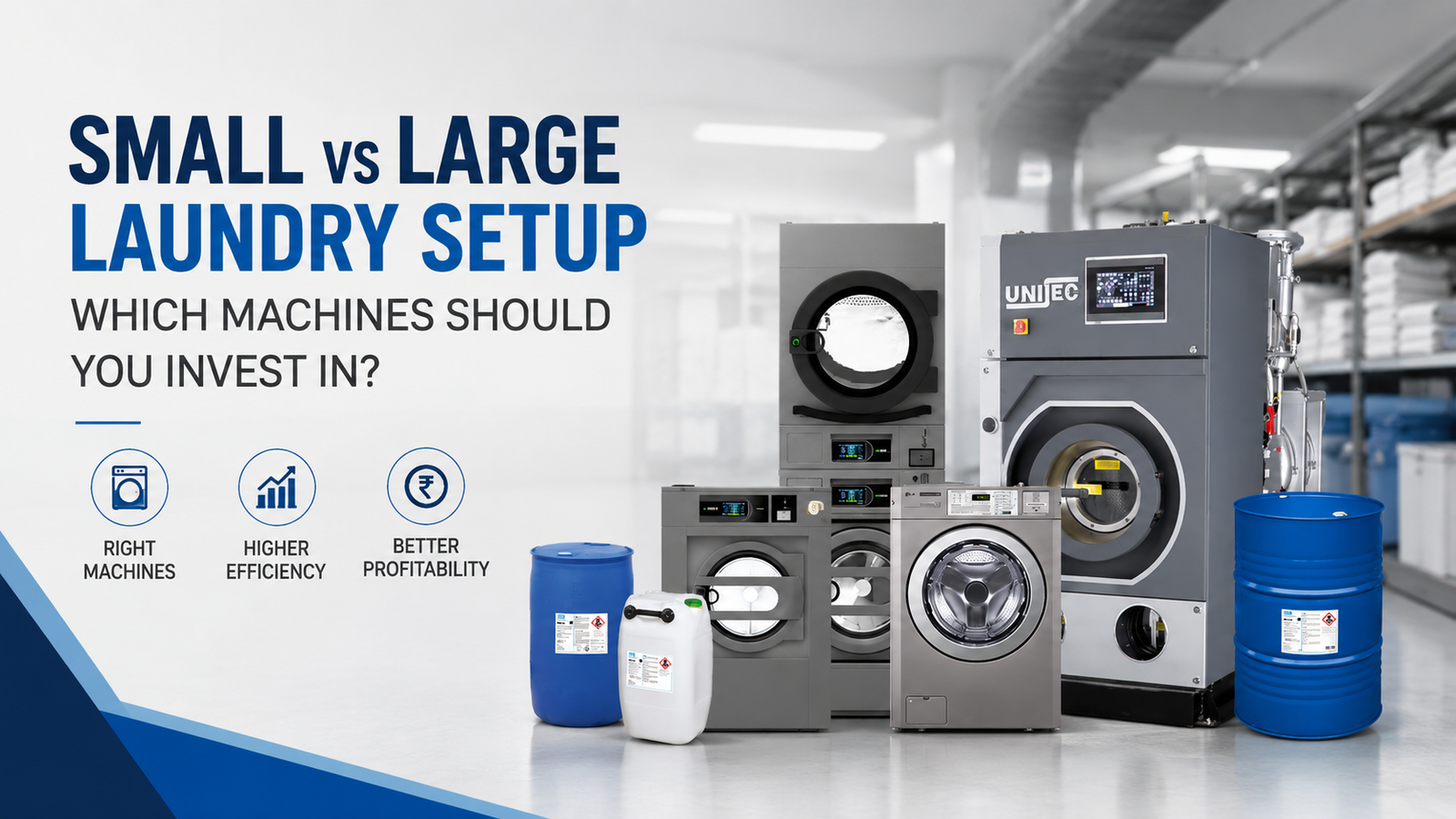
Starting or expanding a laundry business involves one major decision: how much equipment do you actually need?
Buying too little capacity can create bottlenecks as orders increase, while investing in oversized machines can tie up capital and increase utility and infrastructure costs before the business has enough volume to justify them. The right approach is to select laundry business equipment according to expected daily processing volume, customer type, services offered, and future growth.
A neighborhood laundry processing individual customer orders has very different requirements from a commercial plant serving hotels, hospitals, institutions, or multiple retail outlets.
This guide compares small and large laundry setups and explains which machines deserve priority when planning your investment.
What Equipment Does a Laundry Business Actually Need?
Most professional laundries need equipment for four core stages: washing, drying, finishing, and garment handling.
A typical equipment list may include:
- Commercial washing machine or washer extractor
- Commercial or industrial tumble dryer
- Steam ironing equipment
- Vacuum ironing table
- Garment press or finishing equipment
- Laundry trolleys and sorting tables
- Chemical dosing system
- Water treatment equipment where required
- Packaging equipment
Businesses offering specialist garment care may also require a dry cleaning machine, spotting table, steam finishing equipment, or shoe-cleaning equipment.
The exact configuration should be determined by your services rather than by purchasing every available machine.
Small vs Large Laundry Setup: What’s the Difference?
The primary difference is not simply floor area. It is the amount of laundry the operation must process efficiently within its available working hours.
A small laundry setup may serve households, individual customers, salons, gyms, restaurants, or a limited number of local businesses. It typically needs flexible machines capable of processing smaller, mixed loads.
A large commercial operation may process linen for hotels, hospitals, hostels, institutions, or multiple business clients. These facilities require higher-capacity industrial laundry machines, greater automation, stronger utility infrastructure, and carefully balanced production lines.
A practical distinction looks like this:
Factor
Small Setup
Large Setup
Daily volume
100–500 kg
1,000 kg+
Washer capacity
10–30 kg
45–120 kg+
Dryer capacity
10–30 kg
45–120 kg+
Labour
Lower
Dedicated production team
Automation
Basic to moderate
Moderate to high
Customer type
Retail/local B2B
Hotels, hospitals, institutions
Investment
Lower
Higher
Actual requirements vary according to operating hours and business model.
Which Machines Do You Need for a Small Laundry Setup?
For a new business, flexibility and equipment utilization should take priority over maximum capacity.
A practical setup could begin with one or more 10–30 kg commercial washers or washer extractors paired with appropriately sized dryers.
Essential laundry machines for business at this level can include a washer extractor, tumble dryer, steam iron, vacuum table, spotting equipment, chemical dosing system, and basic garment-handling equipment.
Multiple smaller machines can sometimes provide greater flexibility than one large machine because different customer orders can be processed separately.
This is particularly useful for retail laundries handling different fabrics, colours, wash programs, and customer batches throughout the day.
Which Machines Are Required for a Large Commercial Laundry?
Large operations require equipment designed for continuous production.
Depending on processing volume, the plant may use:
- 45–120 kg+ washer extractors
- High-capacity industrial tumble dryers
- Flatwork ironers
- Industrial ironing and pressing equipment
- Automatic chemical dosing
- Garment finishing systems
- Sorting and handling systems
- Steam and utility infrastructure
- Water treatment systems
A large commercial laundry setup must also be designed as a production line.
Installing a high-capacity industrial washing machine provides little benefit if drying or finishing cannot keep pace. Every production stage needs sufficient capacity to prevent bottlenecks.
How to Choose the Right Washing Machine or Washer Extractor
Washing equipment is normally the foundation of the operation.
When comparing a commercial washing machine with a commercial washer extractor, consider extraction performance in addition to wash capacity.
A high-spin commercial washer extractor removes more residual moisture before garments enter the dryer. This can reduce drying time, improve turnaround, and lower energy consumption.
Choose capacity based on realistic daily volume rather than maximum anticipated growth.
For example, a business processing 300 kg daily over 10 hours does not necessarily require the same equipment as a facility processing 1,500 kg during a single shift.
Machine capacity, number of cycles, operating hours, and peak-load requirements should be evaluated together.
What Dryer Capacity Should Match Your Washing Capacity?
Dryer capacity is frequently overlooked during equipment planning.
If washing capacity significantly exceeds drying capacity, wet laundry begins accumulating between processes. That slows production even when the washing machines themselves are operating efficiently.
Your commercial dryer configuration should therefore be balanced with washer output.
Consider:
- Washer load capacity
- Extraction efficiency
- Fabric type
- Expected residual moisture
- Drying cycle duration
- Number of daily loads
- Peak production periods
A high-spin washer extractor may also allow the dryer to complete loads faster because less moisture needs to be evaporated.
For large operations, an industrial tumble dryer should be selected as part of the complete production system rather than independently.
When Should You Invest in Laundry Finishing Equipment?
Finishing becomes increasingly important as businesses begin serving hotels, restaurants, premium garment customers, or institutional clients.
Professional laundry finishing equipment can include flatwork ironers, steam presses, form finishers, vacuum ironing tables, and specialized garment-finishing systems.
For a small operation, manual or semi-professional ironing may initially be sufficient.
As volume increases, however, finishing often becomes a bottleneck. An operation capable of washing and drying 1,000 kg per day gains little from that capacity if finishing can handle only 500 kg.
Invest in finishing automation when labour costs, processing volume, or quality requirements justify it.
How Much Does a Small vs Large Laundry Setup Cost?
There is no universal laundry equipment price because investment varies significantly by capacity, automation, utilities, brand, and services offered.
Your total laundry business investment should account for more than machines.
Budget for:
- Equipment
- Electrical infrastructure
- Plumbing and drainage
- Water storage and treatment
- Steam generation where required
- Ventilation
- Chemical systems
- Installation
- Interiors
- Initial consumables
- Working capital
- Maintenance
A small setup generally requires less capital and can be expanded gradually. Large facilities require substantially greater infrastructure investment but can achieve a lower processing cost per kilogram when operating at sufficient utilization.
Which Laundry Machines Should You Invest in First?
For most businesses, the investment sequence should follow the actual laundry workflow.
Start with washing and extraction capacity. Then ensure drying capacity can support it. Next, invest in finishing according to the type and quantity of garments being processed.
Specialized equipment should follow proven customer demand.
For example, purchasing a dry cleaning machine before developing demand for premium garment care could leave expensive equipment underutilized.
Your first machines should generate revenue consistently — not simply make the facility look more complete.
How to Plan Equipment for Future Business Growth
Planning for growth does not necessarily mean purchasing oversized equipment from day one.
Instead, design the facility so additional commercial laundry equipment can be added later.
Consider future requirements for:
- Electrical capacity
- Gas connections
- Water supply
- Drainage
- Steam
- Ventilation
- Floor space
- Additional machines
A modular equipment strategy can allow a business to increase capacity as customer demand grows without replacing its entire original setup.
Common Laundry Equipment Investment Mistakes
One of the biggest mistakes is selecting machines based only on purchase price.
Businesses should also avoid buying excessive capacity, mismatching washers and dryers, ignoring utility requirements, underestimating finishing needs, and purchasing equipment without dependable after-sales support.
Another common mistake is comparing machines only by kilograms of capacity.
Two machines with similar stated capacity may differ significantly in extraction performance, cycle time, water consumption, controls, energy efficiency, construction, and maintenance requirements.
Evaluate total operating value rather than specifications in isolation.
Small or Large Setup: Which Is Right for Your Business?
A smaller setup is often appropriate for entrepreneurs entering the market with moderate volume, limited capital, and primarily retail customers.
A larger setup becomes more suitable when there is confirmed demand from hotels, hospitals, institutions, commercial contracts, or multiple outlets.
Before purchasing industrial laundry equipment, calculate expected kilograms per day, operating hours, customer mix, average revenue per kilogram, utility costs, staffing, and projected growth.
The right setup is not the biggest one you can afford. It is the one that can process your expected volume efficiently while leaving a practical path for expansion.
How Orgaearth Can Help
Orgaearth helps entrepreneurs, hotels, hospitals, institutions, and established laundry businesses select equipment based on their actual processing requirements rather than simply machine capacity. The process can include understanding daily laundry volume, service mix, available space, utilities, workflow, and future expansion before recommending a suitable equipment configuration.
Orgaearth provides commercial washer extractors, industrial washing machines, tumble dryers, dry cleaning machines, laundry finishing equipment, professional chemicals, and other solutions required for small and large commercial laundry operations. Support can also include project consultation, equipment selection, layout planning, installation and commissioning, operator training, preventive maintenance, spare-parts support, and Annual Maintenance Contracts. This helps businesses create a balanced laundry operation where washing, drying, and finishing capacity work together efficiently.
Contact Us
Orgaearth Laundry Solutions
Plot no 714 Udyog Vihar, Phase 5, Gurugram, Haryana, India- 122016
Email: marketing@orgaearth.com
Contact No.- +91 7042912777
FAQs
What machines are required to start a laundry business?
Most businesses require a commercial washer or washer extractor, tumble dryer, ironing or finishing equipment, chemical systems, sorting equipment, and garment-handling accessories.
How much equipment do I need for a small laundry?
It depends on daily processing volume and operating hours. A small operation may begin with one or more 10–30 kg washers and matching dryers, supported by basic finishing equipment.
What is the cost of a commercial laundry setup?
The cost varies according to capacity, machine technology, utilities, automation, interiors, and services offered. A site-specific equipment and infrastructure plan provides a more reliable investment estimate.
Which washing machine is best for a laundry business?
A commercial washer extractor is often suitable for professional operations because it combines washing with high-speed extraction, which can reduce residual moisture and dryer workload.
What size dryer does a commercial laundry need?
Dryer capacity should be balanced against washer output, extraction efficiency, textile type, and daily production requirements rather than selected by capacity alone.
Which laundry equipment should I buy first?
Prioritize washing and extraction equipment, followed by matching drying capacity and the finishing equipment required for your core services.
How much investment is required for a large commercial laundry?
There is no fixed amount. Investment depends on daily processing capacity, number and type of machines, automation, utilities, infrastructure, installation, and working capital. A project-specific assessment is the most reliable way to estimate the requirement.
How many kilograms do I realistically need to process every day?
Once that figure is clear, selecting the right machines becomes significantly easier — and your investment is more likely to support profitable growth.
- Business
- Technology
- Finance
- Health
- Fashion
- Lifestyle
- Travel
- Food
- Education
- Real Estate
- Automobile
- Entertainment
- Sports
- Pets
- Home Decor
- Gardening
- Parenting
- Wedding
- Beauty
- Gaming
- Photography
- Music
- Movies
- News
- Politics
- Religion
- Astrology
- Law
- Insurance
- Jobs
- Freelancing
- Remote Work
- Blogging
- E-commerce
- WordPress
- OpenCart
- Social Media
- Graphic Design
- Web Design
- Programming
- Mobile Apps
- Artificial Intelligence
- SaaS
- Cyber Security
- Cloud Computing
- Hosting
- SEO
- Content Writing
- Email Marketing
- Affiliate Marketing
- YouTube
- Podcasting
- Interior Design
- DIY
- Crafts
- Art
- Architecture
- Environment
- Agriculture
- Animals
- Fishing
- Hunting
- Survival
- Outdoor
- Fitness
- Yoga
- Meditation
- Mental Health
- Skin Care
- Hair Care
- Makeup
- Jewelry
- Sarees
- Salwar Kameez
- Lehenga Choli
- Kurtis
- Men Fashion
- Women Fashion
- Kids Fashion
- Footwear
- Bags
- Watches
- Luxury
- Shopping
- Coupons
- Electronics
- Smartphones
- Laptops
- Tablets
- Cameras
- Home Appliances
- Kitchen
- Furniture
- Cleaning
- Baby Care
- Senior Care
- Relationships
- Self Improvement
- Motivation
- Quotes
- Festivals
- Events
- Careers
- Remote Work
- Productivity
- Wholesale
- Manufacturing
- Import Export
- Logistics
- Supply Chain
- Human Resources
- Customer Service
