
Local SEO Ranking Factors That Can Improve Your Business Visibility
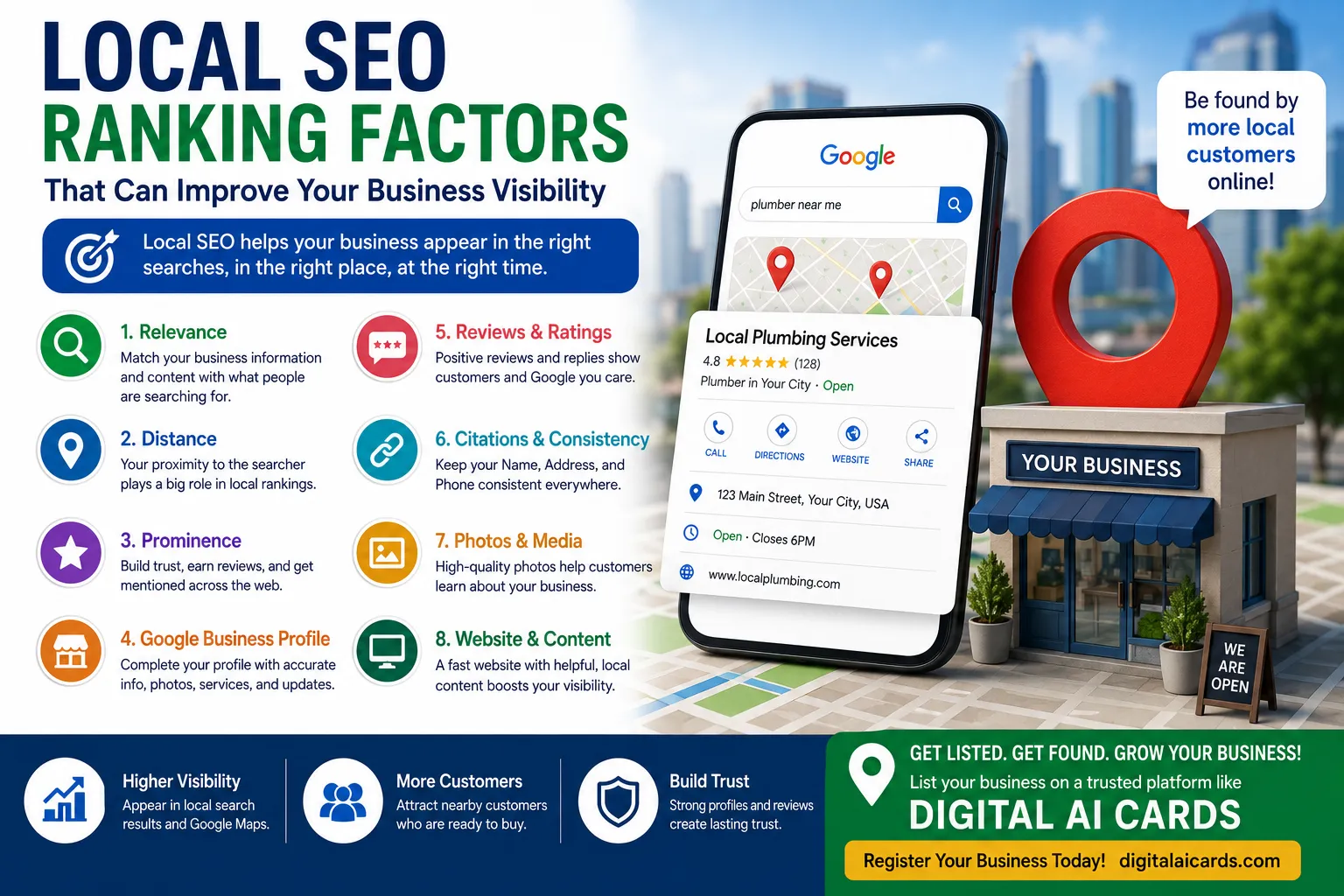
Getting your business to appear in local search results can be challenging, especially when competitors are targeting the same customers and service areas. Many business owners create a website, open a social media account, and claim a business profile but still wonder why their company does not appear prominently when nearby customers search for their services.
The problem is often not one single SEO mistake. Local visibility depends on several signals working together, including how relevant your business is to a search, where it is located, how well known it is, and how accurately your business information is presented online.
Understanding the key local SEO ranking factors can help you identify weaknesses and build a more reliable local search strategy.
What Are Local SEO Ranking Factors?
Local SEO ranking factors are the signals search engines use to determine which businesses are most relevant to users performing location-based searches.
For example, someone searching for "plumber near me" wants businesses that are relevant to plumbing, reasonably close to their location, and trustworthy enough to consider.
Google explains that local results are mainly based on three core factors: relevance, distance, and prominence. These factors work together rather than operating as a simple points-based checklist.
This is important because there is no single optimization trick that guarantees the top position.
1. Relevance to the Search
Relevance means how closely your business matches what the customer is searching for.
If someone searches for "emergency HVAC repair," a business profile that clearly explains its HVAC repair services is more relevant than a general home-services profile.
To improve relevance, make sure your business information clearly communicates:
- What products or services you provide
- Which customers you serve
- Your primary business category
- Important services
- Areas you serve
- Useful business attributes
Avoid stuffing the same keyword repeatedly into your profile. Instead, use natural language that explains your business accurately.
Google specifically recommends providing complete and detailed business information so it can better understand a business and match it with relevant searches.
2. Accurate and Complete Business Information
Incomplete information creates problems for both customers and search engines.
Your business profile should contain accurate details such as:
- Business name
- Address
- Phone number
- Website
- Business hours
- Business category
- Service information
Make sure these details remain current.
If your phone number changes but your old number remains online, potential customers may call the wrong number. If your hours are outdated, visitors may arrive when your business is closed.
Accurate information is therefore both an SEO consideration and a customer-service necessity.
3. Business Category Selection
Your business category helps communicate what your company actually does.
Choosing an overly broad or unrelated category can reduce the relevance of your profile for important searches. Google recommends selecting the most specific category available that accurately describes the business.
For example, a specialized business should avoid choosing a generic category when a more precise option accurately describes its main service.
Think about the category from the customer's perspective: "What would I search for if I needed this business?"
4. Distance and Service Area
Distance is another major part of local search.
Google explains that distance considers how far a business is from the person searching or from the location specified in the search.
This means a business cannot simply optimize its way into every nearby location.
Instead, businesses should accurately represent where they operate. Service-area businesses should clearly communicate their actual service coverage rather than attempting to create artificial locations.
Local SEO works best when your online presence reflects your real-world operations.
5. Reviews and Customer Reputation
Reviews can influence both customer decisions and local visibility.
Google states that review quantity and positive ratings can contribute to local ranking, while responding to reviews shows customers that a business values their feedback.
The goal should not be to collect reviews artificially. Instead:
- Provide excellent service.
- Ask genuine customers for feedback.
- Respond professionally.
- Address legitimate complaints.
- Thank customers for positive feedback.
A steady reputation built through real customer experiences is more valuable than a large number of low-quality or suspicious reviews.
6. Business Prominence and Online Recognition
Prominence refers to how well known a business is.
Google notes that prominence can be influenced by information across the web, including links and reviews.
This is where broader digital marketing becomes important.
Your business can strengthen its online presence through:
- Relevant business directories
- Industry websites
- Local publications
- Community organizations
- Professional associations
- Quality backlinks
- Helpful website content
The objective is not to create hundreds of random listings. Focus on accurate, relevant, and trustworthy references to your business.
7. Consistent Business Listings
Consistency helps reduce confusion.
Your business name, address, phone number, website, and other important details should be accurate across the platforms where your business appears.
This is especially important when customers discover your company through a directory rather than your website.
A useful approach is to create a standard version of your business information and use it consistently when registering on relevant directories.
For businesses looking for another place to establish their online presence, a platform such as USA Business Listings can provide an additional business profile where customers can discover company information.
8. High-Quality Website Content
Your website should support your local search strategy rather than operate separately from it.
Create useful pages that answer real customer questions and clearly explain your services.
For example, a local contractor might publish content about:
- Common repair problems
- Service costs
- Maintenance tips
- Choosing the right service
- Frequently asked customer questions
Use location information naturally where it is genuinely relevant.
Google Search considers relevance, usability, expertise, and other signals when determining useful results, so writing primarily for customers is a better long-term approach than producing pages filled with repetitive keywords.
9. Photos and Visual Information
Photos can improve the quality of a business profile and help customers understand what a company offers.
Depending on the business, useful images may include:
- Storefront photos
- Team members
- Products
- Completed projects
- Office interiors
- Equipment
- Service work
Google recommends adding photos and videos to Business Profiles so customers can better understand the business.
Use genuine images whenever possible instead of generic stock photography.
A Practical Local SEO Checklist
If your local visibility is weak, start with the fundamentals:
- Verify your eligible business profile.
- Complete every important business field.
- Choose an accurate primary category.
- Check your name, address, and phone information.
- Make sure your website works correctly.
- Update business hours.
- Add useful photos.
- Encourage genuine customer reviews.
- Respond professionally to reviews.
- Build relevant business citations and links.
- Publish useful local content.
- Review your information regularly.
These actions address the areas businesses can realistically control.
Final Thoughts
Improving local search visibility is not about finding one secret ranking trick. It is about building a clear, trustworthy, and relevant online presence that accurately represents your real business.
The most important local SEO ranking factors include relevance, distance, and prominence, but businesses can influence these areas by maintaining accurate information, selecting appropriate categories, earning genuine reviews, creating useful content, building reputable online references, and keeping their profiles updated.
For businesses that want to strengthen their digital footprint, creating an additional profile on a relevant business directory can also help customers discover essential company information.
- Business
- Technology
- Finance
- Health
- Fashion
- Lifestyle
- Travel
- Food
- Education
- Real Estate
- Automobile
- Entertainment
- Sports
- Pets
- Home Decor
- Gardening
- Parenting
- Wedding
- Beauty
- Gaming
- Photography
- Music
- Movies
- News
- Politics
- Religion
- Astrology
- Law
- Insurance
- Jobs
- Freelancing
- Remote Work
- Blogging
- E-commerce
- WordPress
- OpenCart
- Social Media
- Graphic Design
- Web Design
- Programming
- Mobile Apps
- Artificial Intelligence
- SaaS
- Cyber Security
- Cloud Computing
- Hosting
- SEO
- Content Writing
- Email Marketing
- Affiliate Marketing
- YouTube
- Podcasting
- Interior Design
- DIY
- Crafts
- Art
- Architecture
- Environment
- Agriculture
- Animals
- Fishing
- Hunting
- Survival
- Outdoor
- Fitness
- Yoga
- Meditation
- Mental Health
- Skin Care
- Hair Care
- Makeup
- Jewelry
- Sarees
- Salwar Kameez
- Lehenga Choli
- Kurtis
- Men Fashion
- Women Fashion
- Kids Fashion
- Footwear
- Bags
- Watches
- Luxury
- Shopping
- Coupons
- Electronics
- Smartphones
- Laptops
- Tablets
- Cameras
- Home Appliances
- Kitchen
- Furniture
- Cleaning
- Baby Care
- Senior Care
- Relationships
- Self Improvement
- Motivation
- Quotes
- Festivals
- Events
- Careers
- Remote Work
- Productivity
- Wholesale
- Manufacturing
- Import Export
- Logistics
- Supply Chain
- Human Resources
- Customer Service
