
The Silent Cycle of Reassurance Seeking: How It Fuels Anxiety and Obsessive Thoughts Instead of Relieving Them
"Are you sure everything's okay between us?" It was the fourth time Amara had asked her partner that same question in two days. Each time, his reassurance brought a few minutes of relief — and then the doubt crept back in, just as loud as before. She wasn't trying to be difficult. She genuinely couldn't tell whether the relief she felt afterward meant the worry was resolved, or simply paused.
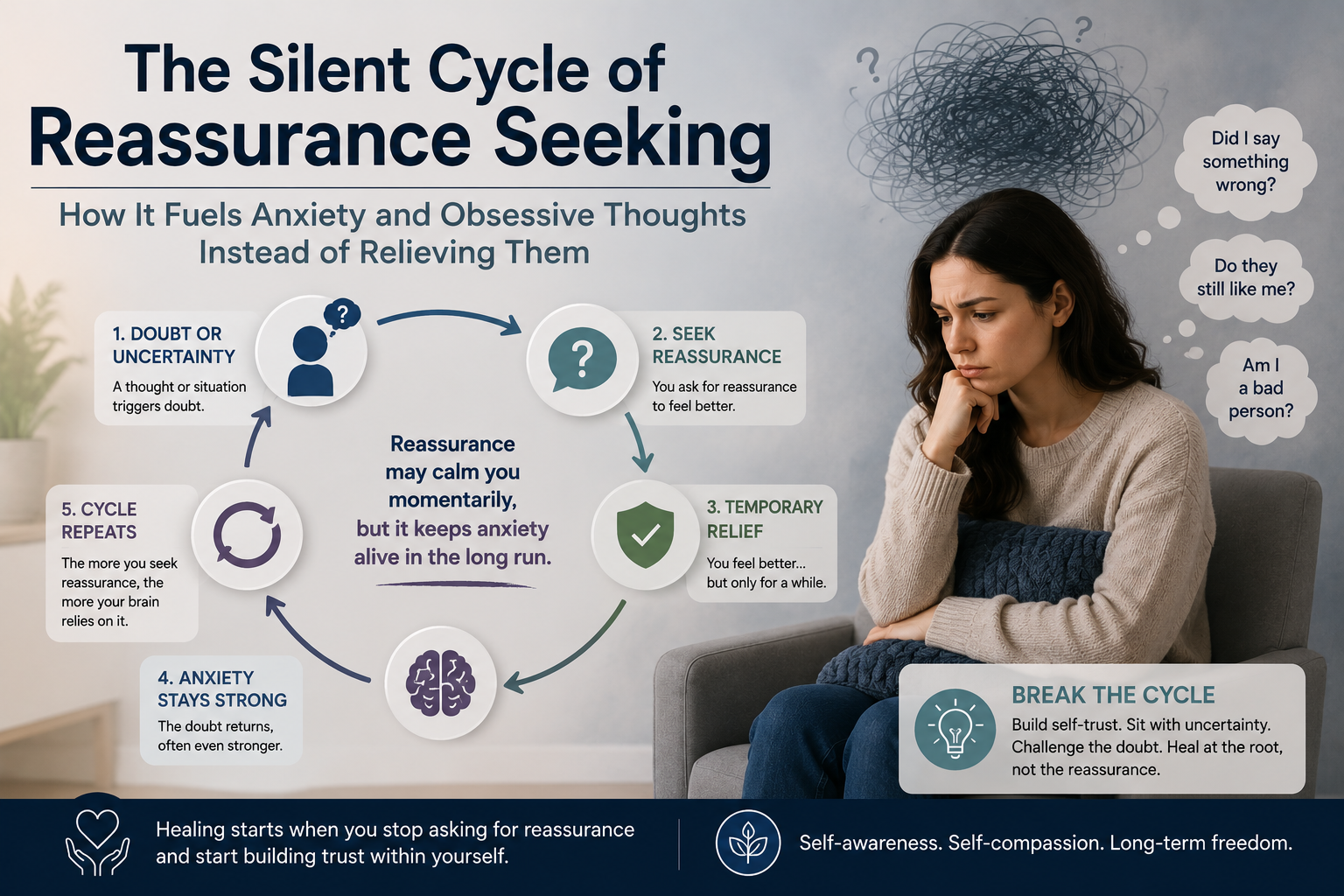
This pattern has a name, and it's far more common than most people realize. Reassurance seeking anxiety describes a cycle in which repeatedly asking for comfort, confirmation, or certainty — from a partner, a friend, a doctor, or even a search engine — temporarily eases anxious feelings, only for the doubt to return, often stronger than before. What feels like problem-solving in the moment can, over time, actually reinforce the very anxiety it's meant to relieve.
This guide explores why this cycle happens, how to recognize it in yourself or someone you love, and what evidence-based approaches can help break it.
In This Guide You'll Learn
-
Why seeking reassurance provides only temporary relief from anxious thoughts
-
How this pattern can unintentionally strengthen obsessive or anxious thinking over time
-
The difference between healthy reassurance and a reassurance-seeking cycle
-
Evidence-based therapy approaches that can help interrupt the pattern
Why Reassurance Feels Like Relief — But Rarely Is
There's a reason this pattern is so hard to recognize from the inside: reassurance genuinely does work, at least for a few minutes. When someone confirms "yes, everything is fine," the brain registers a temporary drop in anxiety. That relief feels like proof the strategy is working.
Research suggests that this is precisely the problem. Each time reassurance relieves anxiety, it teaches the brain that uncertainty is dangerous and must be resolved immediately — rather than tolerated. Over time, the threshold for what feels "unbearable" to sit with gets lower, and the frequency of reassurance-seeking tends to increase, not decrease.
Actionable Takeaway: Next time you feel the urge to ask for reassurance, try setting a five-minute timer before asking. Notice what happens to the anxiety during that pause — often, it shifts on its own, even slightly.
How the Cycle Quietly Builds Over Time
The reassurance-seeking cycle tends to follow a predictable pattern:
-
An anxious or intrusive thought arises ("What if something is wrong?")
-
Discomfort builds, feeling urgent and difficult to tolerate
-
Reassurance is sought — from a person, an online search, or repeated checking
-
Temporary relief follows
-
Doubt returns, often triggering the same question again, sometimes worded slightly differently
Over months or years, this cycle can expand to include multiple people, repeated searches, or elaborate mental checklists — all aimed at achieving a certainty that anxiety, by its nature, rarely allows.
Many individuals may experience this pattern most intensely around specific themes: relationship doubts, health worries, moral or ethical uncertainty, or fears about safety. It's also a hallmark feature often seen alongside obsessive-compulsive patterns, though reassurance seeking can occur with general anxiety as well.
Actionable Takeaway: Try tracking how many times per day you seek reassurance about the same worry, and from how many different sources. This number alone can be a helpful, non-judgmental way to see the pattern clearly.
Healthy Reassurance vs. the Reassurance-Seeking Cycle
|
Feature |
Healthy Reassurance |
Reassurance-Seeking Cycle |
|
Frequency |
Occasional, tied to a specific new situation |
Repeated, often about the same worry |
|
Relief duration |
Lasts a reasonable amount of time |
Fades quickly, prompting the question again |
|
Impact on relationships |
Generally strengthens trust and connection |
Can create strain or frustration over time |
|
Underlying goal |
Genuine information-seeking |
Attempt to eliminate uncertainty entirely |
|
Long-term effect |
Doesn't typically escalate |
Often increases in frequency and intensity |
This comparison isn't about judgment — nearly everyone seeks reassurance sometimes. The distinction lies in frequency, relief duration, and whether the pattern is expanding rather than resolving.
A Real-Life Example: Tom's Story
Tom, a 29-year-old graphic designer, began noticing that he texted his mother almost daily to ask whether she was feeling okay, ever since a minor health scare two years earlier that had since fully resolved. Each reassuring reply calmed him for a few hours before the worry crept back, sometimes prompting a second or third message the same day.
In therapy, Tom recognized that his reassurance-seeking wasn't really about his mother's health anymore — it had become a way of managing uncertainty itself. Working with a therapist trained in Cognitive Behavioral Therapy, specifically Exposure and Response Prevention techniques, Tom gradually practiced sitting with uncertainty for longer periods before reaching out, starting with small, manageable increases in time.
Progress wasn't linear. Some days the urge to text felt nearly unbearable, and Tom didn't always resist it. But over several months, he noticed the intensity and frequency of the urge beginning to soften, and he found himself trusting his own ability to tolerate uncertainty a little more each week.
Evidence-Based Treatment Options
Cognitive Behavioral Therapy (CBT) with Exposure and Response Prevention (ERP)
ERP, a specialized form of CBT, is considered a leading approach for reassurance-seeking patterns. It involves gradually facing uncertainty without engaging in the reassurance behavior, helping the brain relearn that discomfort can be tolerated without needing to be resolved immediately.
Individual Therapy
Beyond structured exposure work, individual therapy provides space to explore what's driving the underlying need for certainty, which often has roots beyond the specific worry itself.
Couples or Family Therapy
When reassurance-seeking involves a partner or family member, couples or family therapy can help loved ones understand the cycle and learn how to respond supportively without unintentionally reinforcing the pattern.
DBT-Informed Distress Tolerance Skills
For those who find uncertainty especially difficult to sit with, Dialectical Behavior Therapy skills focused on distress tolerance can offer practical tools for managing discomfort in the moment.
Treatment often depends on individual needs, and a licensed mental health professional can help determine whether reassurance-seeking is connected to generalized anxiety, OCD, or another underlying pattern.
Actionable Takeaway: If a loved one frequently seeks reassurance from you, consider gently and compassionately delaying your response rather than reassuring immediately — this can be discussed together, ideally with therapeutic guidance, so it doesn't feel like withdrawal of support.
Warning Signs Worth Paying Attention To
Early signs the pattern may be building:
-
Increasing frequency of asking the same question, even after receiving an answer
-
A growing number of people or sources being asked about the same worry
-
Relief from reassurance becoming shorter-lived over time
Red flags that may warrant professional support:
-
Reassurance-seeking significantly interfering with relationships, work, or daily functioning
-
Compulsive checking behaviors (searching online, re-reading messages, repeated confirmation-seeking)
-
Significant distress or panic when reassurance isn't immediately available
If reassurance-seeking is accompanied by thoughts of self-harm or overwhelming hopelessness, please contact the 988 Suicide & Crisis Lifeline (call or text 988) or seek immediate emergency care.
Daily Strategies to Help Interrupt the Cycle
-
Delay tactics — gradually increasing the time between the urge and the reassurance request
-
Uncertainty journaling — writing down the worry and what it would mean to simply not know the answer right now
-
Mindfulness practices — grounding techniques can help tolerate the physical discomfort of anxiety without immediately acting on it
-
Limiting online searching — setting boundaries around "symptom checking" or repeated searches for certainty
-
Identifying the underlying fear — often reassurance-seeking masks a deeper fear worth naming directly, ideally with a therapist's guidance
Support Available in North Carolina
Adults, teens, and couples across Charlotte, Raleigh, Ballantyne, Pineville, SouthPark, and throughout North Carolina have access to therapists experienced in anxiety and OCD-related treatment, including ERP-based approaches, available both in person and via telehealth. Telehealth options can make consistent, structured treatment more accessible for busy schedules.
Common Myths About Reassurance Seeking
Myth: Getting reassurance means the anxiety is resolved. Relief from reassurance is typically temporary, and the underlying anxiety often returns, sometimes more intensely.
Myth: Refusing to give reassurance is unkind. When approached thoughtfully and often with therapeutic guidance, reducing reassurance-giving can actually support long-term healing rather than withholding care.
Myth: This pattern only happens with OCD. While closely associated with OCD, reassurance-seeking is a common feature across various forms of anxiety.
Frequently Asked Questions
Why doesn't reassurance make my anxiety go away for good?
Reassurance typically provides short-term relief while reinforcing the belief that uncertainty must be resolved immediately, which can perpetuate the anxiety cycle over time.
Is reassurance-seeking a sign of OCD?
It can be a feature of OCD, though it also commonly occurs with generalized anxiety and other anxiety-related patterns.
Can reassurance-seeking affect relationships?
Yes, over time it can create strain, particularly if loved ones feel unable to provide enough reassurance to bring lasting relief.
What is Exposure and Response Prevention (ERP)?
ERP is a therapeutic approach that involves gradually facing uncertainty or anxiety-provoking situations while resisting the urge to seek reassurance or perform compulsive behaviors.
How long does it take to break a reassurance-seeking pattern?
This varies by individual, and progress is often gradual rather than immediate, so timelines are best discussed with a treating clinician.
Final Thought
Reassurance seeking often feels like the most logical response to uncertainty — after all, a clear answer seems like it should bring peace of mind. But for many people, this cycle quietly reinforces the very anxiety it's meant to soothe, creating a pattern that grows more demanding over time rather than less.
Recognizing reassurance seeking anxiety for what it is — a cycle rather than a solution — is often the first step toward genuine relief. With structured, evidence-based support, many people find they're able to build a different relationship with uncertainty, one that doesn't require constant confirmation to feel manageable.
If this pattern feels familiar, consider reaching out to a licensed mental health professional in your area or through telehealth to explore what support could look like for you.
- Business
- Technology
- Finance
- Health
- Fashion
- Lifestyle
- Travel
- Food
- Education
- Real Estate
- Automobile
- Entertainment
- Sports
- Pets
- Home Decor
- Gardening
- Parenting
- Wedding
- Beauty
- Gaming
- Photography
- Music
- Movies
- News
- Politics
- Religion
- Astrology
- Law
- Insurance
- Jobs
- Freelancing
- Remote Work
- Blogging
- E-commerce
- WordPress
- OpenCart
- Social Media
- Graphic Design
- Web Design
- Programming
- Mobile Apps
- Artificial Intelligence
- SaaS
- Cyber Security
- Cloud Computing
- Hosting
- SEO
- Content Writing
- Email Marketing
- Affiliate Marketing
- YouTube
- Podcasting
- Interior Design
- DIY
- Crafts
- Art
- Architecture
- Environment
- Agriculture
- Animals
- Fishing
- Hunting
- Survival
- Outdoor
- Fitness
- Yoga
- Meditation
- Mental Health
- Skin Care
- Hair Care
- Makeup
- Jewelry
- Sarees
- Salwar Kameez
- Lehenga Choli
- Kurtis
- Men Fashion
- Women Fashion
- Kids Fashion
- Footwear
- Bags
- Watches
- Luxury
- Shopping
- Coupons
- Electronics
- Smartphones
- Laptops
- Tablets
- Cameras
- Home Appliances
- Kitchen
- Furniture
- Cleaning
- Baby Care
- Senior Care
- Relationships
- Self Improvement
- Motivation
- Quotes
- Festivals
- Events
- Careers
- Remote Work
- Productivity
- Wholesale
- Manufacturing
- Import Export
- Logistics
- Supply Chain
- Human Resources
- Customer Service
