
How Does CRM and ERP Integration Improve Business Operations
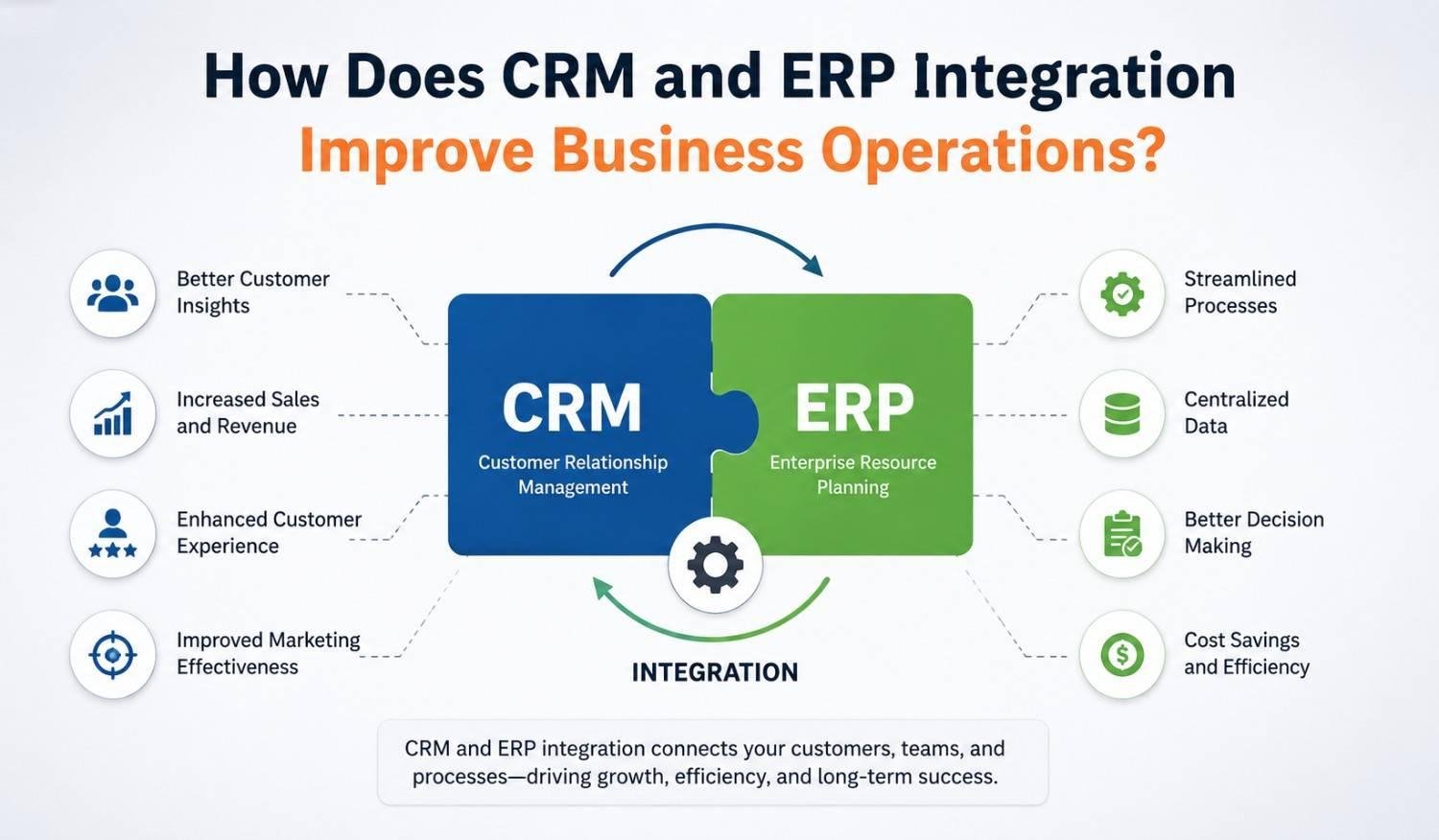
We once sat in a client meeting where three people pulled up three different "final" numbers for the same account — one from sales, one from finance, one from a spreadsheet nobody remembered creating. Nobody was wrong, exactly. They were just all working off different systems that had never been introduced to each other. That, in a nutshell, is the problem most growing businesses run into. And it's also exactly the problem we're going to spend the next few minutes untangling — starting with what actually happens when these two systems finally learn to talk.
What Is CRM and ERP Integration, Really?
CRM handles the customer side — leads, deals, conversations. ERP handles the business side — inventory, finance, operations. On their own, each does its job well. Together, unintegrated, they behave like two coworkers who refuse to cc each other on emails. ERP and CRM integration simply means connecting these systems so data — orders, invoices, customer history — flows between them automatically. No more manual re-entry, no more "let me check with the other team." Think of it as finally introducing two departments that have technically worked together for years but never actually spoken.
The Problem With Keeping Them Separate
We've seen this play out more times than we'd like: a sales rep closes a deal, but the finance team doesn't know until three days later because someone forgot to forward an email. Multiply that by every department, every day, and you get duplicate entries, mismatched records, and a general sense that the business is running on sticky notes. It's not that teams aren't capable — it's that disconnected systems quietly sabotage even capable teams. Which brings us, rather naturally, to why fixing this actually matters.
Key Benefits of CRM-ERP Integration
Unified Customer & Business Data
When systems are integrated, everyone — sales, support, finance — looks at the same numbers. No more "well, my spreadsheet says otherwise." This single source of truth eliminates the awkward back-and-forth of figuring out whose data is correct. Customer details, order history, and payment status update in real time across departments. It sounds simple, almost boring even, but this one shift alone tends to eliminate a surprising number of internal disagreements — the kind that eat up meetings that really didn't need to happen in the first place.
Improved Cross-Department Collaboration
Sales and finance rarely fight because they dislike each other — usually it's because they're working from different information. Integration removes that excuse. When a deal closes in the CRM, the ERP knows immediately, and billing can move forward without a status-check email chain. Departments stop operating like separate companies that happen to share a logo. It's a small technical change with an outsized cultural effect: teams that used to blame "the system" for delays suddenly have far less to argue about.
Faster, More Accurate Decision-Making
Leadership decisions are only as good as the data behind them, and stitched-together spreadsheets rarely inspire confidence. With integration, reports pull from real, current numbers instead of last Tuesday's export. That means faster forecasting, quicker responses to customer trends, and fewer "let me get back to you" moments in meetings. We've noticed decision-making speeds up almost as a side effect — not because anyone tried to make meetings shorter, but because nobody's waiting on someone else to reconcile numbers anymore.
Automation of Repetitive Tasks
Manually copying data between CRM and ERP is the kind of task nobody enjoys and everyone eventually gets wrong. Integration automates it — new customers sync automatically, invoices generate without manual triggers, inventory updates reflect real sales activity. This isn't just a time-saver; it's an error-reducer. Fewer typos, fewer duplicate records, fewer "wait, did we already bill them?" moments. The team gets its hours back for actual work instead of data babysitting, which, frankly, is what most people signed up for anyway.
Better Customer Experience
Customers don't care which internal system holds their data — they just want consistent, accurate service. When support, sales, and billing all see the same customer record, response times improve and mistakes (like double-billing or missed orders) drop sharply. A partner isn't a "CRM development company" outsider handing over software and quietly slipping toward that keyword — it results in a customer experience that finally feels joined-up, rather than assembled from three departments that never quite compared notes.
Scalability for Growing Businesses
What works for twenty employees rarely works for two hundred. Disconnected systems that were "fine for now" tend to buckle under growth — more orders, more customers, more room for things to slip through cracks. Integrated CRM and ERP systems scale far more gracefully, handling increased data volume and complexity without requiring a small army of people manually reconciling spreadsheets. Growth should feel like progress, not like adding more duct tape to an already strained system.
Real-World Use Case
Picture a mid-sized distribution company: sales logs an order in the CRM, but inventory and invoicing live in a separate ERP untouched by that update. Before integration, this meant delayed shipments and confused customers asking where their order went. After integration, the order syncs instantly — inventory adjusts, invoicing triggers, and the customer gets a confirmation without anyone lifting a finger internally. Nothing dramatic happened here — no fireworks, no headline-worthy transformation — just a business quietly running the way it was always supposed to.
Why Businesses Should Work With Experts
Integration sounds simple in theory — "just connect the two systems" — until you're staring at mismatched APIs, inconsistent data fields, and a CRM that stubbornly refuses to understand what the ERP is telling it. This is where working with an experienced ERP software development company actually pays off. It's less about writing code and more about understanding how business processes should flow between systems. DIY integration attempts tend to work fine right up until they don't — usually during a quarter-end close, which is never a fun surprise.
Common Challenges During Integration
Every integration project runs into a few familiar hurdles: messy or duplicate data that needs cleaning before migration, choosing between API-based and middleware approaches, and getting teams to actually adopt the new unified workflow instead of quietly going back to their spreadsheets. None of this is exotic — it's mostly discipline and planning. The businesses that struggle most are usually the ones that treated integration as a weekend project rather than a process that deserves the same care as any other core system.
How to Choose the Right Integration Partner
Look for a team that's done this before — not just technically capable, but familiar with how sales, finance, and operations actually interact day to day. Ask about post-launch support, since integration issues have a habit of surfacing weeks later, not on day one. And be wary of anyone promising a plug-and-play fix in 48 hours flat; real integration, done properly by a capable CRM development company, takes a bit more care than that — and it shows in the long run.
Final Thought
Back to that meeting with three different "final" numbers — it wasn't really a data problem. It was a communication problem wearing a data costume. CRM and ERP integration doesn't fix everything, and it certainly won't make every meeting shorter. But it does mean that the next time someone pulls up "the numbers," there's only one version to argue about — which, if you've sat through enough of those meetings, starts to feel like a small miracle.
FAQs
What is CRM and ERP integration?
It's the process of connecting customer relationship management and enterprise resource planning systems so data flows automatically between sales, finance, and operations — eliminating manual re-entry and mismatched records.
How does CRM and ERP integration improve business efficiency?
It removes duplicate data entry, speeds up reporting, automates routine tasks like invoicing, and gives every department access to the same real-time information.
How long does it take to integrate CRM and ERP systems?
Timelines vary based on system complexity and data volume, but most projects take a few weeks to a few months when handled by an experienced development partner.
Is CRM-ERP integration only for large enterprises?
Not at all. Small and mid-sized businesses often benefit even more, since they typically have fewer resources to absorb the cost of disconnected systems and manual errors.
What should I look for in an ERP software development company?
Relevant experience, clear post-launch support, and a track record of understanding business workflows — not just technical integration skills.
- Business
- Technology
- Finance
- Health
- Fashion
- Lifestyle
- Travel
- Food
- Education
- Real Estate
- Automobile
- Entertainment
- Sports
- Pets
- Home Decor
- Gardening
- Parenting
- Wedding
- Beauty
- Gaming
- Photography
- Music
- Movies
- News
- Politics
- Religion
- Astrology
- Law
- Insurance
- Jobs
- Freelancing
- Remote Work
- Blogging
- E-commerce
- WordPress
- OpenCart
- Social Media
- Graphic Design
- Web Design
- Programming
- Mobile Apps
- Artificial Intelligence
- SaaS
- Cyber Security
- Cloud Computing
- Hosting
- SEO
- Content Writing
- Email Marketing
- Affiliate Marketing
- YouTube
- Podcasting
- Interior Design
- DIY
- Crafts
- Art
- Architecture
- Environment
- Agriculture
- Animals
- Fishing
- Hunting
- Survival
- Outdoor
- Fitness
- Yoga
- Meditation
- Mental Health
- Skin Care
- Hair Care
- Makeup
- Jewelry
- Sarees
- Salwar Kameez
- Lehenga Choli
- Kurtis
- Men Fashion
- Women Fashion
- Kids Fashion
- Footwear
- Bags
- Watches
- Luxury
- Shopping
- Coupons
- Electronics
- Smartphones
- Laptops
- Tablets
- Cameras
- Home Appliances
- Kitchen
- Furniture
- Cleaning
- Baby Care
- Senior Care
- Relationships
- Self Improvement
- Motivation
- Quotes
- Festivals
- Events
- Careers
- Remote Work
- Productivity
- Wholesale
- Manufacturing
- Import Export
- Logistics
- Supply Chain
- Human Resources
- Customer Service
