
Mass Spectrometry Market Growth to Lift Annual Demand to USD 9.4 Billion by 2035
Market Overview and Growth Outlook
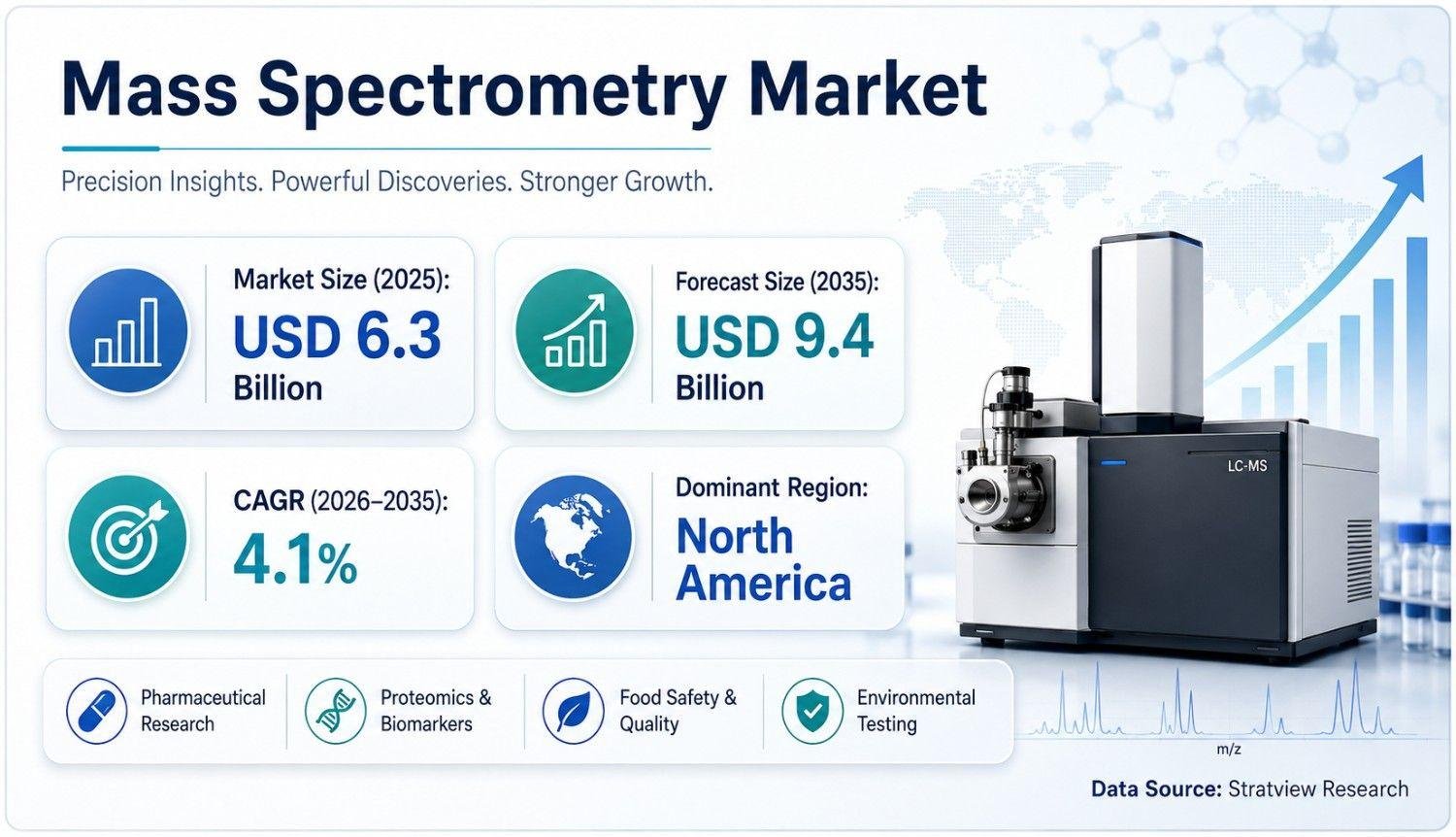
Annual demand in the Mass Spectrometry Market is expected to increase from USD 6.3 billion in 2025 to USD 6.6 billion in 2026. By 2035, annual sales are projected to reach USD 9.4 billion. The market therefore presents a long-term growth trajectory connected to life sciences research, regulated testing, and increasingly complex pharmaceutical development requirements.
The Mass Spectrometry Market is expected to grow at a CAGR of 4.1% during 2026–2035. This growth analysis reflects expanding pharmaceutical and biotechnology R&D pipelines, proteomics and metabolomics activity, precision medicine, clinical diagnostics, biologics manufacturing, and advances in high-resolution and hybrid mass spectrometry technologies.
The global market is expected to generate a cumulative sales opportunity exceeding USD 80 billion during 2026–2035. High-resolution accurate-mass platforms, clinical diagnostics, CROs and CDMOs, and Asia-Pacific are identified as high-opportunity areas. Together, these areas illustrate how technology, applications, end users, and regional investment are shaping the industry outlook.
The trajectory of Mass Spectrometry Market growth is closely tied to the technology’s analytical role. Mass spectrometry enables target identification, lead optimization, pharmacokinetic analysis, impurity profiling, metabolite identification, protein sequencing, glycosylation analysis, peptide mapping, therapeutic monitoring, and biomarker detection across research, development, manufacturing, and clinical environments.
Request a free sample report:
https://www.stratviewresearch.com/Request-Sample/mass-spectrometry-market#form
Market Segmentation Analysis
By Technology Type, Hybrid mass spectrometry, led by triple quadrupole platforms, will continue to lead the market. Triple quadrupole systems deliver sensitivity, selectivity, speed, and cost-effectiveness for routine quantitative analysis. Their established installed base supports demand for new instruments, technology upgrades, consumables, service agreements, and workflow expansion across multiple laboratory categories.
Fourier Transform MS, particularly Orbitrap-type platforms, is expected to record the highest growth. Its ability to deliver high resolving power, mass accuracy, and confident identification of unknown compounds supports advanced applications. Proteomics, metabolomics, lipidomics, biomarker discovery, structural biology, precision medicine, and biopharmaceutical characterization are central to this segment’s demand.
By Product Type, instruments are projected to remain dominant, supported by their high capital value and core position in analytical laboratories. Consumables are poised for the fastest growth because columns, reagents, solvents, sample preparation kits, calibration standards, and ionization accessories require recurring replacement as installed systems and sample volumes expand.
By Application Type, life science research is anticipated to remain the largest application. The segment benefits from widespread use in proteomics, metabolomics, genomics, drug development, biomarker discovery, and biopharmaceutical research. Clinical diagnostics is forecast to grow fastest as mass spectrometry becomes increasingly integrated into screening, toxicology, endocrinology, infectious-disease testing, and cancer biomarker workflows.
By End-Use Industry, pharmaceutical companies retain the leading position because they deploy mass spectrometry throughout drug discovery, development, production, and quality control. CROs are the fastest-growing end-user segment as outsourcing increases. Their growth requires continued investment in advanced platforms, high-throughput workflows, analytical expertise, and capacity for pharmaceutical and biopharmaceutical programs.
Regional Market Insights
North America is projected to remain the dominant regional market. The region benefits from substantial pharmaceutical and biotechnology R&D spending, government-funded research, established academic and clinical institutions, advanced healthcare infrastructure, early diagnostic adoption, and the presence of leading analytical-instrument companies.
Asia-Pacific is forecast to register the fastest growth. Expanding pharmaceutical production, generic-drug manufacturing, biotechnology investment, government research funding, CRO and CDMO activity, academic infrastructure, healthcare spending, food-safety testing, and environmental monitoring are creating additional demand for analytical technologies and related services.
Emerging Trends Shaping the Mass Spectrometry Market
Clinical translation is becoming a more visible component of market development. Therapeutic drug monitoring, newborn screening, infectious-disease testing, toxicology, endocrinology, and biomarker-based diagnostics demonstrate how mass spectrometry is moving into routine healthcare workflows. High sensitivity, specificity, and analytical accuracy are supporting this expansion.
Instrument development is increasingly centered on higher speed, sensitivity, throughput, automation, and AI-assisted data analysis. Cloud-connected software and simplified system operation can lower technical barriers, reshape laboratory workflows, and extend the technology into testing environments requiring repeatable, high-volume, and regulated analytical performance.
Key Growth Drivers of the Market
- Expanding drug-development pipelines raise demand because analytical teams require mass spectrometry from target identification through quality control.
- Proteomics and metabolomics programs increase adoption because high-resolution systems can characterize complex proteins, peptides, metabolites, and biological pathways.
- Growth in biologics creates analytical complexity because monoclonal antibodies, recombinant proteins, vaccines, and advanced therapies require detailed structural and quality assessment.
- Outsourcing to CROs and CDMOs increases platform investment because service providers need scalable testing capacity and specialized expertise.
- Automation and AI-enabled software strengthen laboratory productivity because they improve workflows and widen access beyond traditional specialist research settings.
Competitive Landscape
Top Companies in the Market
Thermo Fisher Scientific Inc.
Agilent Technologies, Inc.
SCIEX (Danaher Corporation)
Bruker Corporation
Waters Corporation
Shimadzu Corporation
PerkinElmer, Inc. (Revvity)
Smiths Detection Group Ltd.
Inficon Holding AG
JEOL Ltd.
AMETEK Inc.
Rigaku Corporation
LECO Corporation
Conclusion and Strategic Outlook
The Mass Spectrometry Market is positioned to reach USD 9.4 billion by 2035, growing at a CAGR of 4.1% during 2026–2035. Its strategic outlook is defined by advanced pharmaceutical pipelines, biologics characterization, omics-scale research, clinical adoption, laboratory outsourcing, high-resolution technologies, and workflow automation. These factors support a broader and more diversified analytical ecosystem.
FAQs – Mass Spectrometry Market
1. What is the current and forecast market value?
The Mass Spectrometry Market was valued at USD 6.3 billion in 2025 and is expected to reach USD 6.6 billion in 2026. Annual demand is forecast to reach USD 9.4 billion by 2035.
2. What CAGR is expected through 2035?
The market is expected to grow at a CAGR of 4.1% during the 2026–2035 forecast period. Its cumulative sales opportunity is expected to exceed USD 80 billion during that period.
3. Why is the Mass Spectrometry Market growing?
Growth is linked to pharmaceutical R&D, biologics, proteomics, metabolomics, clinical diagnostics, and outsourcing. These activities increase demand for sensitive, selective, and high-resolution analytical systems.
4. Which region offers the fastest growth?
Asia-Pacific is projected to register the fastest growth. North America is expected to retain the largest share of the global Mass Spectrometry Market.
5. How should the market’s risk and investment outlook be assessed?
Demand opportunities coexist with high instrument costs, skill shortages, and complex regulatory obligations. Investment decisions therefore depend on application demand, laboratory capacity, technical expertise, and compliance requirements.
- Business
- Technology
- Finance
- Health
- Fashion
- Lifestyle
- Travel
- Food
- Education
- Real Estate
- Automobile
- Entertainment
- Sports
- Pets
- Home Decor
- Gardening
- Parenting
- Wedding
- Beauty
- Gaming
- Photography
- Music
- Movies
- News
- Politics
- Religion
- Astrology
- Law
- Insurance
- Jobs
- Freelancing
- Remote Work
- Blogging
- E-commerce
- WordPress
- OpenCart
- Social Media
- Graphic Design
- Web Design
- Programming
- Mobile Apps
- Artificial Intelligence
- SaaS
- Cyber Security
- Cloud Computing
- Hosting
- SEO
- Content Writing
- Email Marketing
- Affiliate Marketing
- YouTube
- Podcasting
- Interior Design
- DIY
- Crafts
- Art
- Architecture
- Environment
- Agriculture
- Animals
- Fishing
- Hunting
- Survival
- Outdoor
- Fitness
- Yoga
- Meditation
- Mental Health
- Skin Care
- Hair Care
- Makeup
- Jewelry
- Sarees
- Salwar Kameez
- Lehenga Choli
- Kurtis
- Men Fashion
- Women Fashion
- Kids Fashion
- Footwear
- Bags
- Watches
- Luxury
- Shopping
- Coupons
- Electronics
- Smartphones
- Laptops
- Tablets
- Cameras
- Home Appliances
- Kitchen
- Furniture
- Cleaning
- Baby Care
- Senior Care
- Relationships
- Self Improvement
- Motivation
- Quotes
- Festivals
- Events
- Careers
- Remote Work
- Productivity
- Wholesale
- Manufacturing
- Import Export
- Logistics
- Supply Chain
- Human Resources
- Customer Service
