
Aircraft Sensors Market Forecast to Reach US$ 2.3 Billion by 2034 with Flight Control Systems Expanding
Market Overview and Growth Outlook
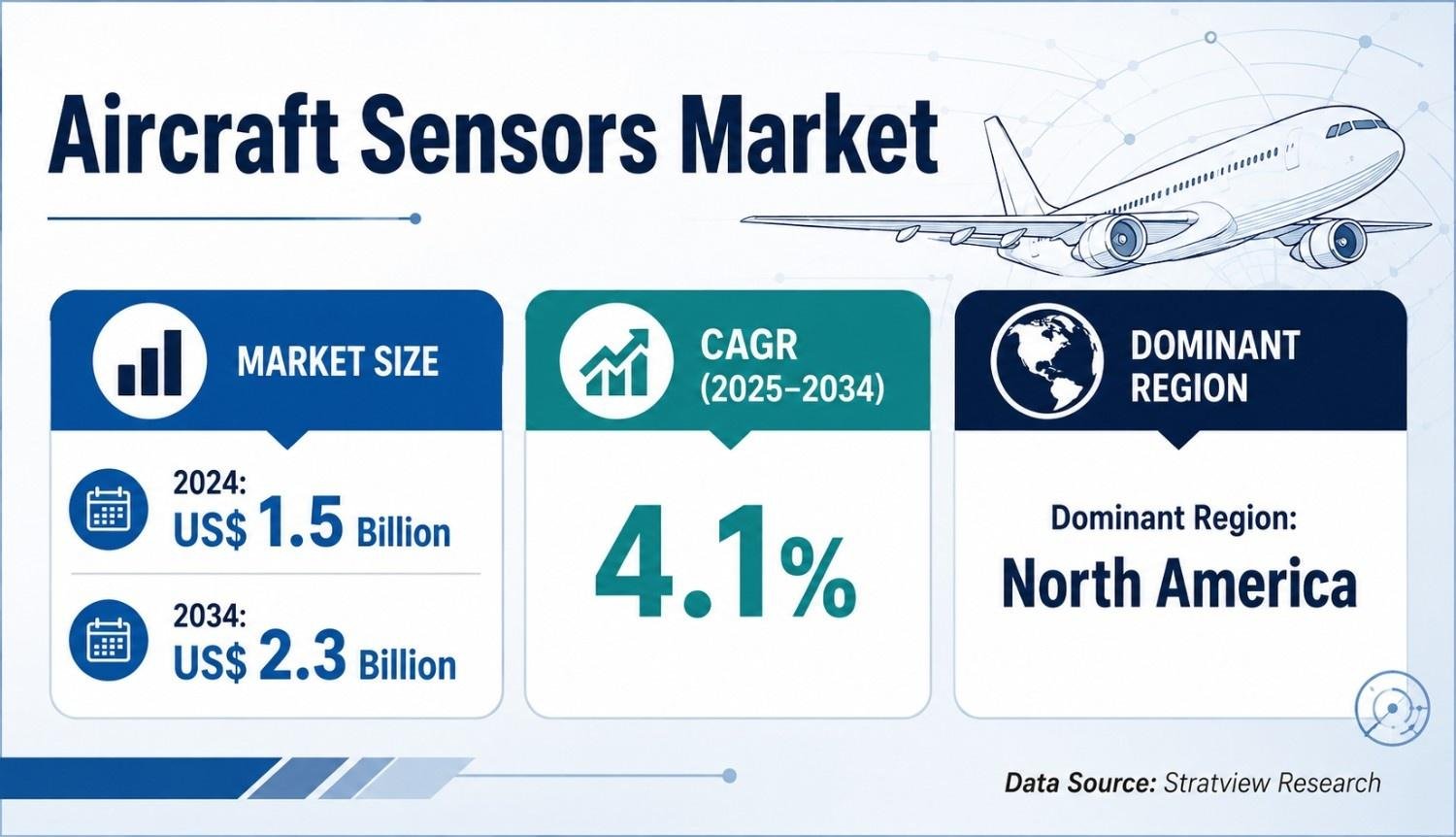
The Aircraft Sensors Market forecast indicates expansion from US$ 1.5 billion in 2024 to US$ 2.3 billion by 2034. The market is likely to grow at a CAGR of 4.1%, driven by aircraft production rates, next-generation models, advanced avionics, automation, fleet modernization, and UAV adoption.
“The Aircraft Sensors Market is expected to grow at a CAGR of 4.1% during 2025-2034.” Demand is increasing because sensors supply real-time feedback across aircraft systems, helping pilots and onboard computers monitor critical parameters, improve safety, and support operational efficiency.
The Aircraft Sensors Market forecast is shaped by rising automation. Flight control systems are expected to grow rapidly as aircraft adopt fly-by-wire systems, more-electric architectures, and sensor-driven control networks for safety, precision, and stability.
Request a free sample report:
https://www.stratviewresearch.com/Request-Sample/Aircraft-Sensors-Market#form
Market Segmentation Analysis
By Aircraft Type, the market is segmented into Commercial Aircraft, General Aviation, Regional Aircraft, Military Aircraft, Helicopter, and Unmanned Aerial Vehicle. Commercial Aircraft is expected to remain the dominant platform and also the fastest-growing category, supported by production of fuel-efficient aircraft and extensive sensor integration.
By Sensor Type, the market is segmented into Pressure Sensor, Temperature Sensor, Position Sensor, Force/Torque Sensor, Inertial Sensor, and Other Sensors. Pressure Sensor remains the dominant sensor type, while Temperature Sensor is expected to grow fastest due to thermal monitoring requirements in engines, ECS, avionics cooling, and electric or hybrid platforms.
By Application Type, the market is segmented into Engine, Landing Gear, Wheels & Brakes, Flight Control Systems, Cabin, Cargo & ECS, and Other Applications. Engine remains the leading application, but Flight Control Systems are expected to witness the fastest growth due to automation and fly-by-wire adoption.
By End-User Type, the market is segmented into OE and Aftermarket. OE is expected to remain both larger and faster-growing, reflecting the high number of sensors integrated into new commercial, military, UAV, electric, and hybrid-electric aircraft platforms.
Regional Market Insights
North America will continue to be the largest regional market, supported by major aerospace OEMs, commercial aircraft production, military programs, and technological leadership in sensor integration. The region’s established aerospace base sustains strong demand for high-performance sensors.
Asia-Pacific is expected to witness the highest growth rate over the forecast period. Expansion is driven by aircraft manufacturing capacity, defense budgets, localized supply chains, indigenous aircraft programs, and fleet growth in China, India, and Japan.
Emerging Trends Shaping the Aircraft Sensors Market
Flight control modernization is a major trend. Position, force, and pressure transducers are increasingly important for monitoring pilot inputs, actuator movements, and aerodynamic loads in real time, especially as aircraft rely more heavily on automation and electronic control systems.
Another trend is the rise of lightweight, low-power, high-response sensors. The source connects these requirements to eVTOLs, advanced UAVs, electric aircraft, hybrid-electric aircraft, and more-electric aircraft, where stability, maneuverability, energy monitoring, and system reliability depend on precise sensing.
Key Growth Drivers of the Market
- Fly-by-wire adoption increases demand for sensor networks that monitor pilot inputs, actuator movements, and aerodynamic loads.
- More-electric aircraft architectures require responsive and redundant sensors for control surface complexity and system precision.
- Engine monitoring demand remains strong because sensors support fuel pressure, oil pressure, turbine temperature, vibration, and airflow monitoring.
- Advanced UAVs and eVTOL concepts increase demand for lightweight, low-power sensors that support stability and maneuverability.
- OE aircraft deliveries expand sensor demand as new platforms integrate sensing systems across multiple safety-critical functions.
Competitive Landscape
Top Companies in the Market
- AMETEK Inc.
- Amphenol Corporation
- Crane Holding Co.
- Collins Aerospace
- Curtiss-Wright Corporation
- Honeywell International, Inc.
- Meggitt PLC
- Safran SA
- Sensata Technologies, Inc.
- TE Connectivity Ltd.
- Thales Group
- TransDigm Group, Inc.
Conclusion and Strategic Outlook
The Aircraft Sensors Market is forecast to reach US$ 2.3 billion by 2034, growing from US$ 1.5 billion in 2024 at a CAGR of 4.1%. The forecast is anchored in aircraft production, OE installations, commercial aircraft demand, engine applications, and rapid growth in flight control systems.
Strategically, the market is moving toward sensor architectures that improve safety, precision, automation, and operational efficiency. Suppliers able to meet aerospace requirements for reliability, miniaturization, avionics integration, and rapid production turnaround will remain important to the competitive landscape.
FAQs – Aircraft Sensors Market
What is the Aircraft Sensors Market forecast?
The Aircraft Sensors Market is forecast to reach US$ 2.3 billion by 2034. The market was valued at US$ 1.5 billion in 2024.
What CAGR is expected?
The Aircraft Sensors Market is expected to grow at a CAGR of 4.1% during 2025-2034. This reflects steady demand across aircraft types, sensor types, applications, and end users.
What is driving demand?
Demand is driven by aircraft production, next-generation aircraft models, advanced avionics, automation systems, fleet modernization, UAVs, and safety-related regulatory requirements. Flight control systems are also expected to witness the fastest application growth.
Which regions matter most?
North America is expected to remain the largest regional market. Asia-Pacific is expected to be the fastest-growing regional market during the forecast period.
What is the market outlook for suppliers?
The outlook is steady, but suppliers must compete on accuracy, reliability, miniaturization, weight reduction, advanced avionics integration, compliance with aerospace safety standards, and cost-effective turnaround. These factors define competitiveness in the Aircraft Sensors Market.
- Business
- Technology
- Finance
- Health
- Fashion
- Lifestyle
- Travel
- Food
- Education
- Real Estate
- Automobile
- Entertainment
- Sports
- Pets
- Home Decor
- Gardening
- Parenting
- Wedding
- Beauty
- Gaming
- Photography
- Music
- Movies
- News
- Politics
- Religion
- Astrology
- Law
- Insurance
- Jobs
- Freelancing
- Remote Work
- Blogging
- E-commerce
- WordPress
- OpenCart
- Social Media
- Graphic Design
- Web Design
- Programming
- Mobile Apps
- Artificial Intelligence
- SaaS
- Cyber Security
- Cloud Computing
- Hosting
- SEO
- Content Writing
- Email Marketing
- Affiliate Marketing
- YouTube
- Podcasting
- Interior Design
- DIY
- Crafts
- Art
- Architecture
- Environment
- Agriculture
- Animals
- Fishing
- Hunting
- Survival
- Outdoor
- Fitness
- Yoga
- Meditation
- Mental Health
- Skin Care
- Hair Care
- Makeup
- Jewelry
- Sarees
- Salwar Kameez
- Lehenga Choli
- Kurtis
- Men Fashion
- Women Fashion
- Kids Fashion
- Footwear
- Bags
- Watches
- Luxury
- Shopping
- Coupons
- Electronics
- Smartphones
- Laptops
- Tablets
- Cameras
- Home Appliances
- Kitchen
- Furniture
- Cleaning
- Baby Care
- Senior Care
- Relationships
- Self Improvement
- Motivation
- Quotes
- Festivals
- Events
- Careers
- Remote Work
- Productivity
- Wholesale
- Manufacturing
- Import Export
- Logistics
- Supply Chain
- Human Resources
- Customer Service
